Former player of Kyiv’s ‘Dynamo’ Viktor Moroz spoke about a period in his career.
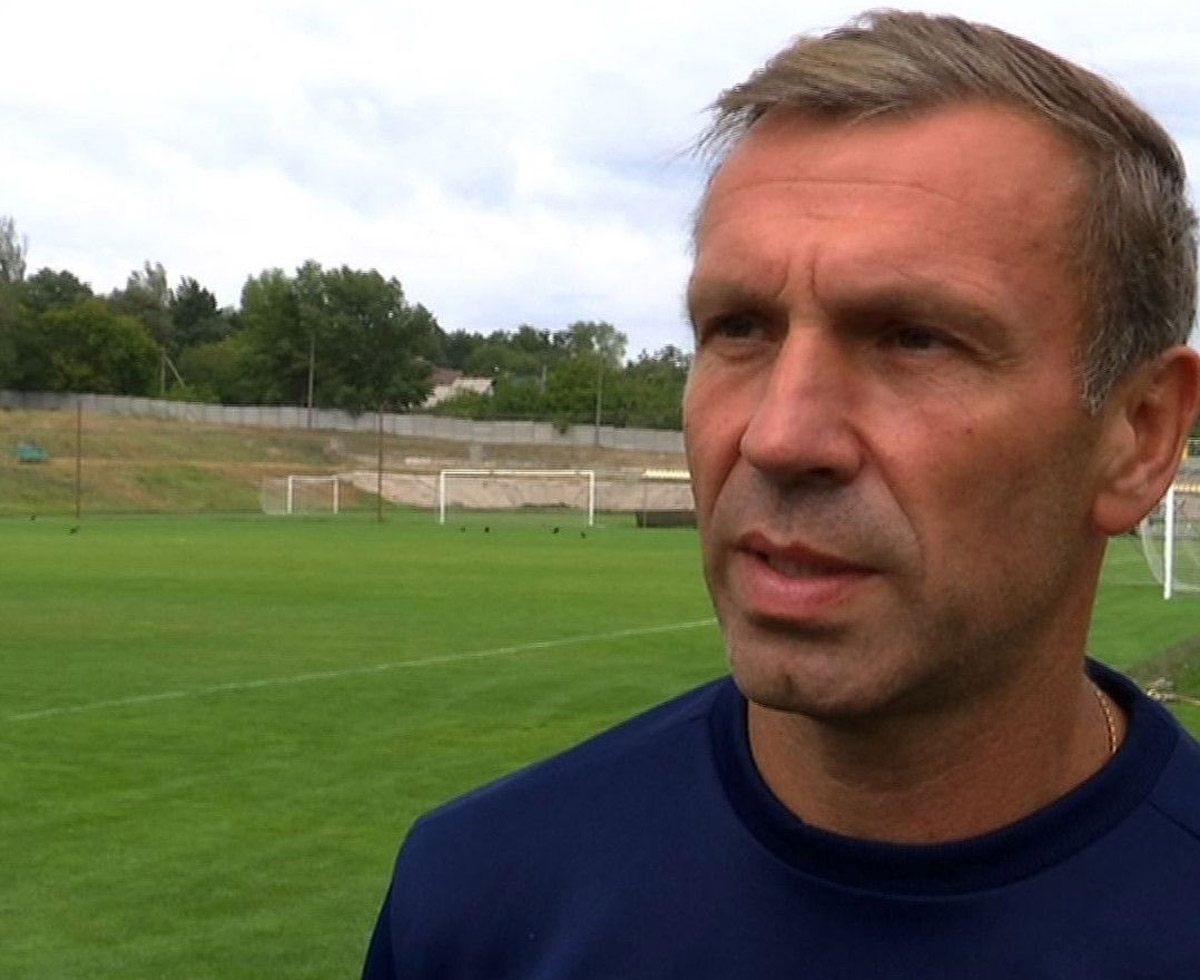 Viktor Moroz. Photo — fcdynamo.com
— Viktor, it is known that before joining the ‘Dynamo’ school, you began playing football at ‘Voskod’ in the Darni ts’kyi district. Did everything in ‘Dynamo’ start from Nivky?
— Yes. I joined here around 1980. Before that, I trained at ‘Voskod’ for about two years. Then I received an invitation from San Sanych Shpakov. I graduated from school with him. In our group at that time was Igor Zhabchenko, and together with Alexey Drotsenko and Sasha Moroz, with whom I started back then, we are now training youth at the Dynamo academy.
It is noteworthy that more than 30 years have passed since our graduation, and we still find reasons to meet. The merit belongs primarily to San Sanych in that such a number of children not only fell in love with football but also made it their profession. I have already been training here for seven years, at the school in Nivky. Children’s football has become another stage in my professional activity. I enjoy it.
“Times and values have changed today”
— Most coaches who experienced football in the 90s lament that children have changed not for the better...”
— Of course, mentalities, personal relationships, and interests outside of football have changed. But all children are different. Just like in our time. It is now common to say that children are glued to their phones and computers. However, there’s no escaping this. These are the times. If you don’t adapt to this, you won’t be able to live normally or study in school or university.
— When you started playing football, representatives of the star ‘Dynamo’ of 1975 were still performing, and the future star team who would reach their peak in 1986 was already declaring themselves. Now you cannot attract children to ‘Dynamo’ with loud victories because there are none...
— First of all, I wouldn't divide ‘Dynamo’ by periods. Because the victories of the 60s, 70s, 80s, and 90s are victories of one ‘Dynamo’. They all belong to the club. The current generations continue what previous generations achieved, stepping out with the same letter “D” on their chests. Yes, if before ‘Dynamo’ was the pinnacle of dreams for young footballers from all over Ukraine, now the situation has changed. So much so that not all children in Kyiv even dream of ‘Dynamo’.
This is not a problem, but a dilemma — how and with what to motivate the children so that ‘Dynamo’ is still as prestigious for them as it once was for us. We must take into account that before, ‘Dynamo’ was a national team. Today, times and values have changed. However, there are still children for whom ‘Dynamo’ is in their hearts now. I believe that everything depends on the values instilled by parents. For example, if parents have been fans of ‘Dynamo’ all their lives, how will that child grow up?
— Do you already have students you can be proud of?
— That’s a very strong word — students. I can remember children whose development has noticeably benefited from my input. Alongside other coaches. Anton Tsarenko is currently on loan at the Polish ‘Lechia’ from Gdańsk, Igor Gorbach and Artem Slesar are on loan to ‘Zarya’.
— You were lucky not just to watch from the side, but to play from a young age with footballers who won the Cup Winners' Cup in 1986. Because back then players recovering from injuries or serving suspensions played for the reserve team.
— There were also those who lacked match practice. I must say that the reserves were constantly next to the main team: they lived on the base in the same two-story building, ate in the same cafeteria, trained on adjacent fields. There were even times when a player from the first team got injured during training and was immediately replaced by someone from the reserve team. After graduating from school in 1986, I was transferred to the reserves by Viktor Kolotov.
Unlike my peers, it was easier for me because I was occasionally involved in working with the Dynamo reserves even earlier. Yes, of course, it was great when the opportunity arose to play with someone from the main players. Let’s say, with Igor Belanov, Alexander Zavarov, Ivan Yaremchuk, Vasily Rats. Oleg Blokhin did not play for the reserves while I was there, but I was already thrilled at the opportunity to closely observe such a figure: to see what he can do, how he thinks, and how he realizes his thoughts.
— Was there respect for hierarchy?
— There was respect. It didn’t matter where — in the cafeteria, on the bus, on the road. Only on the football field were we all equal. At the same time, we did not have any bullying. Yes, we carried the balls. But here in the corridor next to the office where we are talking, there’s a photograph of my friend Andriy Bal with a net of balls. A participant in two World Cups, but the crown did not fall from him.
— You spent four years in the reserves. Lobановskyi would only let you into the main team for Federation Cup matches, which were perceived as training friendlies. Didn’t this situation bother you?
— Blokhin once aptly noted in this context: “You need to be in the right place at the right time.” Yes, there were many good players in our reserves who lacked patience and transferred somewhere. People just wanted to play. Where — it didn’t matter. That was their choice. I endured until the end. There was also a moment when I was on the brink and wanted to leave. I had offers not only from Ukraine but also from the Czech Republic.
I went to talk to Valeriy Vasilievich, explained the situation. “There’s an offer,” I said, “I’d like to play.” Lobановskyi listened and said: “Wherever you go, you will play. But you are a Kyivian, you grew up in this school, you have gone through so much in the reserves. Understand, you are not being kept here for nothing. A generational change will happen soon. Would you not want to prove to yourself that you are worth something in this team?”
This was my first, albeit brief, conversation with Lobановskyi face to face. He convinced me. And in 1990, I was already in the squad of the main team. I played a little, but I understood that my time was already near.
“In Prague, we couldn't stay on our feet. We didn't have the ‘sorokonozhka’ shoes that are everywhere now”
— It just so happened that one of your first full matches for the main team in the spring of 1991 was played at ‘Camp Nou’ against Johan Cruyff’s genius ‘Barcelona’, a team that played exemplary football for that time.
— Before the match, Anatoly Puzach (at that time already the head coach of ‘Dynamo’ — ed.) asked: “Are you scared?” I answered honestly: “I’m not scared. I want to play.” Yes, there was anxiety, but there should be before any game, even a less responsible one. Of course, I could have said that I was not yet ready. However, for me, it was a unique chance to play in such a stadium against such a team. This desire was stronger than the fear.
Yes, and we played wonderfully, barely missing a surprise after a 2:3 home defeat. And we would have created one if Yuran had hit the net when he attempted to lob Subisareta from the edge of the penalty area with the score at 1:0. Moreover, our team had enormous potential. Many of us came up from the reserves after many older guys began moving to foreign clubs. We were unlucky in one respect: it was a time of change, the Union was collapsing, and young football players were also parting ways.
— Is it true that after the strict Lobановскyi with his authority, Puzach seemed too soft to the players and thus did not have much influence on the team?
— We were young. We didn’t care — whether it was Lobановскyi, Puzach or someone else. Moreover, Aнатолий Кириллович had Viktor Kolotov and Vladimir Veremeyev as his assistants, people we worked with in the reserves. Puzach had enormous experience as a player as well as a longtime assistant to Lobановskyi. His authority was never questioned. We worked diligently. Yes, after ‘Barcelona’, we had a poor start in the last USSR championship. For some time, we were in the last places. However, this was a period of our adaptation to real professional football. The team believed in itself, gained confidence, and by the end of the season was already fighting for medals.
— ‘Dynamo’ was not stable throughout the entire season: they could win 2:0 against ‘Spartak’ in Moscow and soon lose against the hypothetical ‘Pamir’. There were also strange matches like the one in Kyiv against ‘Paktakor’, where we led 3:1 and allowed the opponent to equalize in mere minutes. I've heard the version that it was fixed...
— No, there’s no such thing. Such “swings” are typical of youth. Keep in mind that in the previous season the experience of playing for the first team was only had by Oleg Luzhnyi, Akhrik Tsweiba, Sergey Shmatovalenko, Boris Derkach, Sergey Zayats, Sergey Yuran, and Oleg Salenko. Sergey Kovalyets, Yuri Moroz, Stepan Betza, Andrey Annenkov, Andrey Oleksanenko, Oleg Matveev, I were essentially newcomers. We just lacked a little in many matches. But remember our final match against ‘Torpedo’ in Moscow. Based on its results, we could either have bronze or come in fifth, because in case of a loss, ‘Chornomorets’ could overtake us. We lost 0:1 back then, although we showed decent football. We lacked something at the end. But no one made a tragedy as the coaches understood well that a new team was being formed.
— In this team, there was no representative of the ‘Dynamo’-1986 left. Who was its leader in the locker room? Did the team bond together?
— In 1990, even before leaving, such a figure for us was Andrey Bal, who united us with his experience and subtle sense of humor. And after him, perhaps, I would highlight Akhrik Tsweiba. No wonder we then chose him as captain. On the field, however, our leader could be someone different every time.
— This ‘Dynamo’ is also remembered for taking part in the first Champions League tournament in history. Moreover, they sensationally outplayed ‘Benfica’ in the first match with Yuran in the lineup.
— The fact that we could do this surprised no one. Nevertheless, we showed that we are capable. And the packed stands certainly helped. Most of us were not used to playing in front of such a crowd, so we felt a special lift and responsibility.
And then we went to a match against ‘Sparta’ in Prague. It was December 11, the last game of the year. Few remember what happened there. They only know that we lost 2:1. However, do not be lazy, find the recording, and see in what conditions we played. At that time, the organizers of the match were not yet required to have a heated pitch. We arrived in the morning for training — the temperature was -2, and the pitch was frozen. We began to look for footwear to simply stay on our feet on this ice. The studs slid, and even regular sneakers were no good. We didn’t have ‘sorokonozhki’, which are everywhere now. To be precise, two guys received this footwear from the youth team of the USSR — Sergey Zayats and Oleg Salenko. The rest of us went out to play on ice like cows in the evening during the match. While ‘Sparta’ came out in their ‘sorokonozhki’. There’s your answer.
“Come on, you’ll start with the second team. Prove yourself there”
— The next four matches of that Champions League were played in the spring. But you didn’t play then...
— For the first match against ‘Barcelona’, we prepared in Italy, near Bari. We spent three weeks there for pre-season training. I started to feel unwell there. I didn’t understand what was going on. Upon my return to Kyiv, we tried blockades and injections with doctor Volodymyr Malyuta. It turned out that I had an inguinal hernia. Literally, on the eve of departure for Barcelona, the coaches called me and asked if I could come out to play. I honestly answered: “As I'm conducting training, then I can come out. But to play at full strength — no.”
Apparently, a bit of time was lost then, about a month and a half. The surgeon in the military hospital diagnosed me instantly. If I had gone to him right away, I might have avoided complications and wouldn’t have had to sit out so long. As a result, I underwent surgery after which I rehabilitated for six months. For a month, the doctor forbade me to lift even a cup of tea. I could only walk slowly.
— Therefore, it happened that you missed the first championship of Ukraine, which was held through an accelerated procedure. In three months...
— I recovered just before the final match against ‘Tavriya’. I even hoped to play, but the coaches didn’t dare to put me out after such a break.
— ‘Suspilne Media’ recently posted a recording of the second half of the final with Puzach’s post-match commentary. Anatoliy Kyrylovych did not look too downcast.
— He held up well. That loss to ‘Tavriya’ was a huge shock for all of us. For everyone — players and coaches. To say that we were upset would mean saying nothing. We went to Lviv, where the final was held, only for victory. We set off for the away trip dressed in matching festive suits. We had to win. However, we fell short.
— I’ve heard the opinion that after the top league of the USSR championship, being in the same tournament as Shepetivka's ‘Temp’, Akhtyrka's ‘Neftianyk’, many players lost motivation and during that time even drank themselves...
— That’s not true. Although we did lose motivation. Yes, those teams that at one moment found themselves at our level, we were obliged to win against. But before each of those matches, we had to additionally motivate ourselves. Believe me, it’s not easy to play when there’s no zest, and you just force yourself to step onto the field. I don’t want to diminish the teams like Ternopil’s ‘Niva’, ‘Prykarpattia’, or ‘Bukovyna’ that we played against then. Those teams did everything they could. But after ‘Barcelona’ and ‘Benfica’, it was difficult for us to focus on them.
— In any case, the defeat to ‘Tavriya’ was not forgiven to Puzach. Instead, ‘Dynamo’ was headed by Mykhailo Fomenko. But you didn’t play a single minute with him.
— I had a conversation with Mykhailo Ivanovych. “Come on, you’ll start with the second team. Prove yourself there,” he said. I understood that I was not counted on. In ‘Dynamo-2’ were also Yura Moroz, Hintaras Kvitkauskas.
— In the end, you spent a year in the first league...
— If I didn’t love football, one could say that I was suffering. However, I wanted to play, even having the conviction that no one was waiting for me in the first team. That’s why I gave my all for ‘Dynamo-2’.
“Moroz will decide for himself where it’s more convenient for him to play”
— How did the opportunity with Israel come about?
— Spontaneously. When I realized that there was no future for me in ‘Dynamo’, at first there was a possibility of going to Turkey through Veremeyev. But one day I leave the ‘Dynamo’ stadium and meet Viktor Kondratov, who, unfortunately, had recently left us. Word for word, I tell him about my search. “Look, my kum Mikhail Sokolovsky has gone to Israel, trying to get a coaching job there,” Viktor Ivanovych says. “I’ll call him and tell him you’re available.”
In the evening, Sokolovsky himself called. He said he was in ‘Hapoel’ from Beer Sheva, but hadn’t signed a contract. “They are interested in you. Can you come to their gathering in Romania?” — he asks. I agreed. It turned out to be not so simple to get there. The gathering took place in a city four hours away from Bucharest, in the mountains. I couldn’t reach by plane, and there were no tickets at the train station either. I was advised to come closer to the departure of the train and negotiate with the conductor. I did just that. Interestingly, when the train crossed the Ukrainian-Romanian border, I was the only passenger in two cars. And when I arrived in Bucharest, representatives of the team were already waiting for me.
I arrived, had lunch, and they immediately offered me to play in a friendly match in two hours. “We understand that you had a long road. Could you play at least one half?” “I can.” As a result, I played the entire match. And after it, the coach and club president suggested signing a contract. Besides me, there were two other Ukrainians at the tryout in ‘Hapoel’ — Alexander Shcherbakov and Igor Korneets. In the end, only Sasha stayed. At that time, there was a limit on legionnaires. They took a Romanian, Daniel Skentea, as the third. Shcherbakov, however, had a recurrence of a knee injury. He played a few games at the start of the season and could not continue his performances.
— And you in two seasons scored 20 goals. This is despite the fact that you didn’t score a single one for ‘Dynamo’. Didn’t you accidentally play as a forward?
— No, as in ‘Dynamo’, I played in the midfield. I also assisted many times back then. Things just clicked when I felt the coach’s trust. The team was then led by Viko Khaddad. When he announced the lineup for the game, he said where each player would be playing. For ten footballers. “And Moroz will decide for himself where it’s more convenient for him to play,” he would say.
I immediately started scoring. If I’m not mistaken, I scored four goals in the first six matches. Local journalists were very surprised when I responded that I hadn’t scored at all in ‘Dynamo’. “First manage to break through there, and then think about goals,” I said.
We played well then. We became third together with ‘Hapoel’ twice in a row. For Beer Sheva, that was a big success. I was very popular then. But usually, what happens? A foreigner leaves a team, and in two or three years, no one remembers him. However, even last year, journalists from Israel called me, took a long interview, and already in 2025 as well.
— Did you learn Hebrew?
— Yes, I speak. Although at first, it was impossible to understand anything by ear. However, over time, when I constantly listened, I began to separate one word from another. Then I started asking what the words I heard most often meant. Of course, it helped that there were always people who spoke our language around. For example, the team’s doctor was from Berehove in Transcarpathia. When I realized that I was already forming words into phrases, I asked the club president to hire a teacher who would help me with correct pronunciation. This is how I remember it to this day. Of course, it’s harder for me to speak, so to speak, about medicine and politics because my vocabulary is limited. However, I speak freely on football topics.
— You played for ‘Hapoel’ at the age of 25-27 — a golden age for football. Were there any options at that time that you could accept Israeli citizenship? At least to not be considered a foreign player.
— No, there was no talk about that. Getting Israeli citizenship is very difficult. You need to have at least some connection to this country...
Later on, when I moved to ‘Maccabi’ from Tel Aviv, one of the central newspapers took an interview with me. A big one, on the spread. With the headline “Viktor — the fox”. And I still didn’t learn to read in Hebrew. I knew how to write my name and surname, read ratings for a game, but no more than that. And here I became curious: why was such a headline given? I needed to read everything. I did this with outside help. The riddle was at the end. There, the journalist asked me: “You speak Hebrew wonderfully. Why then did you come with a translator?” I replied, “I understand Hebrew only when we are talking about money.” To understand this joke, you need to know the mentality of Israelis.
“You are the only Russian I communicate with. And only because you have Israeli citizenship”
— Was ‘Maccabi’ the peak of your career?
— In terms of age, yes. The other thing is that in Tel Aviv I was one of many. They even asked me if I regretted leaving ‘Hapoel’, where I was adored, to join ‘Maccabi’. But how can I regret a period in which the team finished with a championship and a cup win? Yes, I played less, but those are nuances. ‘Maccabi’ is a special team, among which there were many local stars, say, Avi Nimni, Itzik Zohar, Nir Klinger. They had special relationships with journalists. There I found out that players have “their” journalists, to whom they tell what to write about them. If, for example, they are not played, they write that the coach is not that good. Of course, under such circumstances, it’s easier for a coach to go the way of least resistance and put a local star.
About a month before the end of the championship, I got injured. During this period, I approach coach Dror Kashtan. “What are your plans? — I ask. — Do you see me in the team?” We talked for about an hour and a half, and I never heard a direct answer. Finally, I ask again: “I’m going home, so I need to understand what I can expect.” Kashtan replied: “I don’t even know if I will be kept.” “He’s being evasive,” I think. We’ve just won the championship and the cup, collecting 83% of the points. Why shouldn’t he be kept? However, I learn in Kyiv that Kashtan was indeed dismissed.
— You lived in war conditions in Israel and now live in Ukraine. Where was it scarier?
— Probably now with us. Although…. When I walked with my child in Israel past a bus stop, I wouldn’t approach when a bus was pulling up. Terrorist acts were a frequent phenomenon. By the way, at the time when a bus exploded on Dizengoff Street, in the very center of Tel Aviv (on October 19, 1994, 22 passengers and a suicide bomber died — ed.), I did not reach the tragedy scene due to circumstances because I decided at the last moment to turn around to go to the doctor.
— At ‘Maccabi’ you played with Alexander Uvarov, a former goalkeeper of the USSR national team, a Russian. Do you communicate with him now?
— Yes, we are still friends. While it was possible, he hosted me in Kyiv, and I hosted him in Tel Aviv. He still works at ‘Maccabi’. When the full-scale war began, I told Sasha: “You are the only Russian I communicate with. And only because you have Israeli citizenship.” Uvarov seems to understand us; he knows what it’s like when missiles fly into Tel Aviv.
— How did you become a scout for ‘Dynamo’?
— They offered and I became one. The head coach of the team at that time was Yuri Semin, and our scouting group was looking for players for him. We went, scouted footballers for specific positions, communicated with other scouts. This was work that was done worldwide. In particular, I traveled to matches of the Brazilian championship, to the African Cup of Nations.
— Were there players who ended up in ‘Dynamo’ on your recommendation?
— It doesn’t work that way now. A player is not followed for a month or two. And not just by one scout. Different people go to the scouting, giving their assessments. And then a certain decision is made based on the conclusions of different scouts.
— Earlier, the main criterion was the player’s match with Dynamo’s style. Did Semin also adhere to that direction?
— The Dynamo style is a somewhat abstract concept. Yes, ‘Dynamo’ played football with an athleticism bias and emphasized play through the flanks. But matches were also different; it depends largely on who you play against. In modern football, players are picked not under the style, but under the coach and his requirements.
Ivan Verbitsky