A graduate of Kyiv’s Dynamo, Sergiy Lyulka recalled his journey in the capital team.
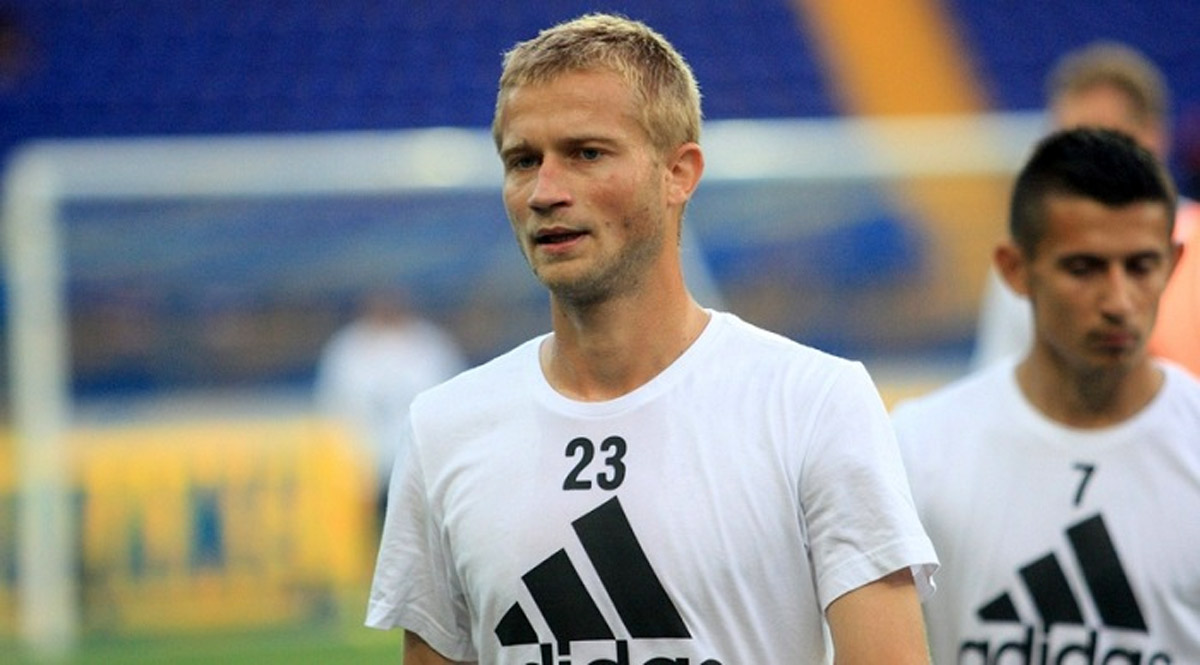 Sergiy Lyulka
— At what age did you come to football?
— At six.
— But you weren’t like many others who had been with the ball since infancy?
— No. My father introduced me to football. (Smiles).
— How did that happen?
— Nowadays, it’s not like it used to be. In my childhood, there weren’t as many clubs. For example, when we arrived at Dynamo, there were 300 kids eager to join. We took various tests. I didn’t really know what a ball was. I was standing there with my hands in my pockets, and then I got a poke from the coach, so I never kept my hands in my pockets again. (Smiles). The person who did that was Oleksandr Vasylovych Leonidov.
— The first coach of Blokhin, Lozynskyi, Bohdanov! How were you selected if you weren’t familiar with the ball?
— I took the tests, kicked the ball a few times. Maybe the coach saw something. Although at first, I was placed in the second team. Each of those teams had about 30 players. Gradually, many boys began to drop out, and I, surprisingly, improved a lot, and after three months, I was moved to the first team.
And that’s when I fully "fell in love" with football. But again, all this happened largely thanks to my father, who constantly practiced with me in the yard. Dad loves football very much, but he also watches all kinds of sports and doesn’t miss any broadcasts featuring Ukrainians.
— And when did you fall in love with the game of millions, which footballers did you admire?
— There wasn’t just one. When we were at Dynamo matches, we handed out balls, shook a fabric in the shape of a ball in the center of the field before Champions League matches, so all those great Dynamo players have forever remained in my memory.
— Did you analyze your matches at home with your father?
— After every game, until we got home, I listened for an hour and a half. (Smiles). I was scolded for mistakes. I didn’t like it at all, sometimes I got nervous, but then I understood that it was correct.
“Kalytvyntsev took me to Dynamo-2”
— And with which footballers who went with you to the Dynamo school are you still in touch?
— Not many. Just recently, I spoke with Andriy Bohdanov. Our paths have somewhat diverged. However, if I met any of the guys, I would gladly communicate.
— Were you immediately positioned as a winger?
— At first, I was a winger, and in the Academy, Serhiy Pavlovych Velychko, who led us until graduation, moved me to defense.
— Even while playing for the second Dynamo team, you made it to the U-21 European Championship in 2009. Did Yuriy Kalytvyntsev see you as a stable core player?
— I don’t know, maybe. Because I practically didn’t play in Dynamo-3. Everything somehow didn’t work out, but then at the Makarov Memorial, I probably showed myself well, and Yuriy Mykolaiovych took me to Dynamo-2.
I was already playing there regularly, alternating with matches for the double. Sometimes, over one weekend, I played for both teams. After all, Kalytvyntsev was simultaneously a national team coach, whose core consisted of Dynamo players.
Furthermore, I went into the Euro as a core player.
— And it all ended in the 15th minute of the first match against Slovenia…
— Yes. I tore my meniscus. I don’t consider this to be loud words, but I think that if it weren’t for the injury, I would have played all the matches.
“Instead of celebrating, I was preparing for surgery”
— Can we say that the injury affected your career prospects?
— No. What you’re talking about happened later.
— How much time in your football life have you missed due to injuries?
— Unreal amount. Meniscus, cruciate ligaments, I tore my ankle twice, strained the back of my thigh, broke ribs in the Czech Republic…
— At the European Championship 2009, you were essentially in the role of a fan. Was your mood not the best?
— Not without that, but the main thing is that the Ukrainian national team won that European Championship. I was so happy as if I were on the field. (Smiles).
— For the victory at the European Championship, the team was awarded good bonuses, around $25,000 each. Did everyone receive this?
— No. It depended on the amount of time spent on the field. I, for example, received $10,000. This was my biggest bonus in my career.
— Were you able to celebrate the triumph?
— No. I immediately went to Kyiv to prepare for surgery.
“2011 was a year of disappointments”
— Your growth in the Dynamo structure continued until 2012, and then you went on loan to the Czech Republic. Were you disappointed?
— This is what I wanted to tell you when you asked about injuries and prospects. When I recovered from the meniscus, I gained great shape, running on the field like crazy.
In 2011, a U-21 national team was assembled, and earlier the federation leadership had assembled a U-20 national team, to which I also made it. Pavlo Yakovenko included me in a few matches. In the last friendly match before going to Euro-2011 (U-21), which I think I could have also gone to, I was pushed from behind in the middle of the first half, and I fell awkwardly, tearing my cruciate ligaments.
And that was still half the trouble. When I arrived at the Dynamo base, Andriy Husyn met me and informed me that I was supposed to go to the gathering with the first team.
My despair was limitless! Not only did I possibly miss out on the European Championship, but I also squandered my chance to get into the first team of my home club!
By the way, at that time, my contract was also expiring. But that issue was resolved. Husyn negotiated and I re-signed the agreement on better terms. I had surgery in Rome, and after five months, I was already in shape.
However, there was uncertainty regarding whether they would take me to the first team or not. During this time, Vyacheslav Zakhovailo arrived and offered me to try my luck in the Czech Championship. I spoke with the coaches, my parents, and decided to give it a try.
— Did Yuriy Kalytvyntsev and Andriy Husyn see potential in you to eventually be in the first team?
— I think they did. No one would keep just anyone at Dynamo. And who would show themselves would be seen over time.
— How do you remember your Czech stage of your career at Slovan, where you moved in the summer of 2012?
— To be honest, it was a bit difficult. I was young, and such foreign experience didn’t come easy for me, but it was necessary. Fortunately, I understood a bit of Czech, but my teammates didn’t understand me. (Smiles).
What do I remember? Matches in the Champions League and Europa League. And the championship itself was of decent level.
“Blokhin took me to France as a tourist”
— Why did you spend only half a year at Slovan?
— I had a one-year loan, but in winter, Dynamo returned me early. Probably, it was not in vain that I left. The team was led by Oleg Blokhin, and he wanted to see all the loaned players. Not everyone, however, went to the gathering, but I found myself among the chosen ones.
During Oleg Volodymyrovych’s time, I had the best chance to enter the first team. The coach trusted me, I played in all friendly matches. And his attitude towards me was good.
I didn’t make the application for the Euro cups since I was already registered with Slovan. However, Blokhin took me to France as a tourist for the Europa League match against Bordeaux in the Round of 32.
Unfortunately, it didn’t come to the championship. Before the resumption of official matches, Dynamo held a friendly with Dynamo-2 in its arena. And wouldn’t you know it, at the very beginning of the game, I tore ligaments in my ankle! I recovered just at the end of the season, which ended for me without any playing practice.
— Did you have to go on loan again?
— Then I went on loan to Hoverla with Vitaliy Buyalsky. At that time, Oleg Volodymyrovych constantly checked in on our progress in Uzhhorod. But unfortunately, when I returned, Blokhin was no longer with the team.
— Your competitor in Dynamo was Danilo Silva?
— Yes, he was too. (Smiles). Domagoj Vida was brought in as a central defender, but then they started positioning him on the right as well. The competition on my flank was quite intense.
— Did you get a hard time from more experienced partners during training?
— When Blokhin was there, he didn’t allow the veterans to "rough up" the young ones. He would stop those attempts if someone tried to do so along with one of his assistants.
“Hoverla owes $70,000”
— Did you stick to a regimen?
— Basically, yes. I didn’t think it necessary to hang around somewhere. (Smiles).
— Was Uzhhorod your best stage of your career regarding playing time?
— I wouldn’t say so. The first season was indeed great; we had a good team. While there was money, everything was wonderful. But then everything fell apart. Hoverla turned into a sort of "Dynamo-2".
— Do Hoverla still owe you?
— Yes.
— How much?
— Part of the salary was paid by Dynamo, and the other part by Hoverla. So for a year, the Uzhhorod team didn’t pay me about $60,000-$70,000.
— Did you try to reclaim the money through official channels?
— And where to file a complaint if they declared bankruptcy? And I had not the largest sum of debt.
— Then there was a decent company at Hoverla — Vitaliy Buyalsky, Vitaliy Lysytskyi, Maksym Shatskikh, Volodymyr Lysenko, Aleksandar Trishovych. Why did you only finish 12th in the championship?
— The thing is we assembled only before the start of the season. Nevertheless, we played quite well in the first half of the year. Yes, we lost matches to competitors at times. But if this team had lasted at least another year in this form, I am sure the result would have been much better.
— Was it comfortable working with Vyacheslav Hroznyi?
— Yes, everything was fine. Vyacheslav Viktorovych could joke and support the team. Sometimes, after victories, he would gather the team and treat them at his own expense. (Smiles). He loved to conduct theory. We could listen to the coach for two hours with a break for a coffee break. (Smiles). For instance, if Hroznyi liked how the team was performing in training, it could continue and the session would stretch to two and a half hours.
“In Uzhhorod, we supported ourselves”
— I heard that during your time at Hoverla, you were trying to get back to the Czech Republic.
— During the training camp with Uzhhorod, I went for a trial at Sparta. To be exact, a player of the Czech national team was supposed to leave that team. I arrived, trained for three days, played in a friendly, and... at the last moment, it turned out that the player was staying, and I returned to Hoverla again.
— Did you part ways with Dynamo in the winter of 2016?
— I asked to be released as a free agent. I saw no sense in continuing to suffer in rentals. I had wanted to do this earlier, when I was at Hoverla, I was called by Vorskla. I had a conversation with Vasyl Sachko, but no one would buy me.
But when I came to Ihor Mykhailovych Surkis, I managed to say only five words: “Could you let me go?” And then I listened to a 40-minute lecture from the president and returned to Uzhhorod. (Smiles). The second time I addressed this issue, they released me.
In the last year at Hoverla, there were no more arrivals, no meals, and some guys didn’t have money, so we provided them with lunch since we received part of our salary from Dynamo. Initially, our rent was paid, but then, when late payments began, we had to spend a lot of our own money to resolve domestic issues. As a result, everything fell apart.
— Was Oleksandr Shufrych managing the club well?
— He was probably not the main person in making financial decisions. But the fact remains that Hoverla disappeared from the football map of the country.
— If we sum it up, why didn’t you manage to make it into the Dynamo first team?
— Injuries are injuries, but you must also seek reasons within yourself. Maybe I didn’t do enough in some areas. That’s how fate played out, but I don’t regret anything. What is, is.
Sergiy Demyanchuk