Polish specialist Maciej Kendzerek, who joined the coaching staff of the Kyiv Dynamo team at the end of August, gave his first interview on collaboration with the Ukrainian club on Polish radio Radio TOK FM.
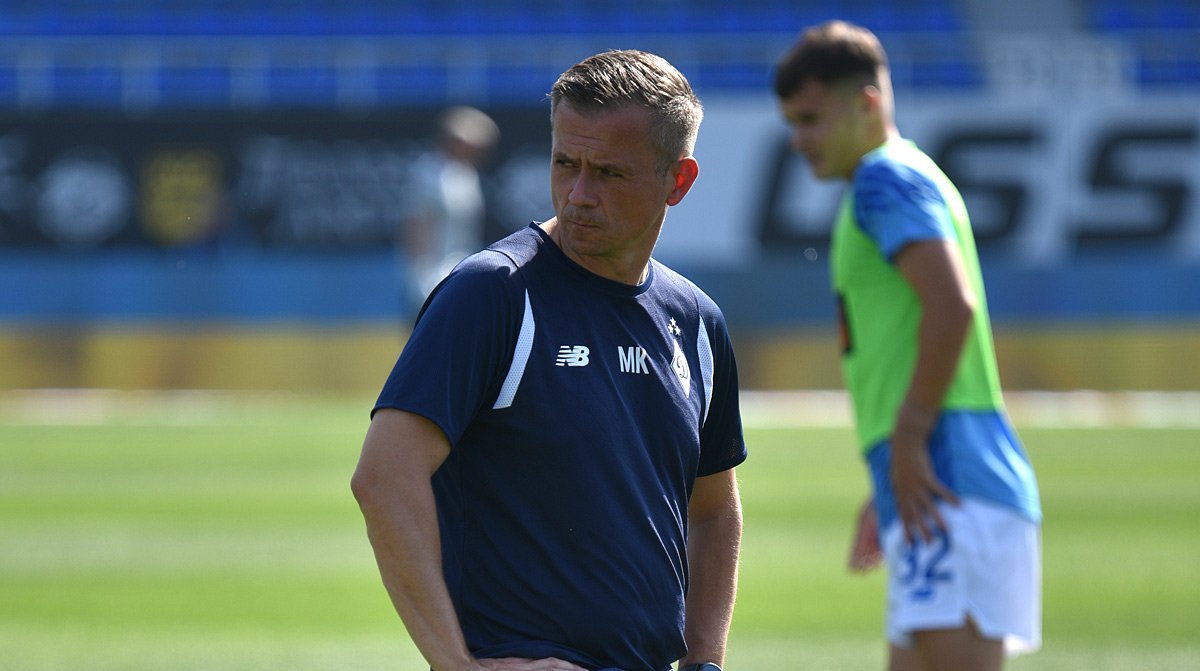 Maciej Kendzerek. Photo — Yu. Yuryev
— Why did you choose Kyiv’s Dynamo?
— The biggest advantage of continuing my career, without a doubt, was that Kyiv Dynamo is a very well-known brand. I dare say it’s the most popular club in this part of Europe, one of the most popular and the biggest. This was undoubtedly the main plus for me. For other reasons too, the offer that came in was very tempting. Above all, playing in European competitions is very important to me, because it’s a great experience. That’s why I decided to spend this season at Dynamo.
Of course, I primarily considered the current situation in Ukraine, studied this information, checked and double-checked. So I knew what I was signing up for, and I was aware of the situation. It’s true we also spend a lot of time away from Kyiv. For example, recently, we played against Crystal Palace in Lublin. We first went to Lviv, spent a few days there, then moved from Lviv to Lublin, and spent a few days there as well. So, I would say, it’s more like living out of a suitcase. But right now we are in Kyiv. During the break for international matches, we train at our base.
— How did your family react to your choice?
— On a purely human level, leaving aside the football aspects, I won’t deny that this decision wasn’t easy for me, and I understand that it creates a certain stress for my loved ones. But I try. I try to stay in touch regularly, keep everyone updated every morning, report, so to speak, and somehow minimize all of this.
— For a long time, Poland’s representative, Tomasz Kedziora, played at Dynamo. Did you consult with him before accepting Dynamo’s offer?
— Yes, you could say he was my informant. To start, Tomasz is a very valuable person here at Dynamo, a player who achieved a lot here. If anyone ever gets a chance to visit the club’s base, they will see how many photos Kedziora is in. On many — even individually. Not every player gets such recognition. Tomasz is really a very, very respected person here, and it might not be a big secret if I say that he was the one with whom the Dynamo owners and coaches consulted about me. Tomek was the one who, so to speak, endorsed my candidacy.
Tomasz helped me a lot. He told me everything about the place I was going to move to, how to behave here in terms of what is acceptable and what is not. His help was invaluable in many respects. And initially, when, for example, I needed something and couldn’t find it, I could always call or write to him, and he helped me several times. So I’m very grateful to him for all of this.
— How is your adaptation to the country and the current situation going?
— It’s already a bit easier for me here. I’m learning the language. I’ve seen certain things with my own eyes, and my worldview has changed significantly. In fact, it changes significantly every day. Honestly, I imagined all of this a little differently. Even though outwardly the city functions, in general, normally, and life seems to flow as usual day by day. At the same time, memory is greatly honored here, all those who fought for their country. And there are many, many places with photographs, pictures of people who died at the front. Their age is particularly striking: many young people — 19, 18, 20 years old. So this is very noticeable.
And before the first match I was at here, everything started with the club honoring the memory of Dynamo fans who died at the front. There was a moment of silence, and the relatives of these fans were invited onto the field. The players thanked them for defending Ukraine. And, of course, there were photographs. All these guys are really, really young...
I can’t say for sure that I was ready for all of this, because every day you see something abnormal and unnatural. And I really wouldn’t want the same thing to happen in our country because it’s truly terrifying.
— Let’s move on to football. Ukrainians need football as a respite, an opportunity to escape, and as a demonstration to society that living in a country devastated by war is possible. Is that so?
— I think so. I think this is exactly the role of all football competitions here. It’s evident how much people need it, how much they need a break from this harsh reality, from this harsh everyday life. It’s probably the most important role of the Ukrainian championship at the moment because I see it with my own eyes and know what I’m talking about. The situation is complicated because many have either lost someone in the war, or they have someone currently at the front. And during these 90 minutes, people may get a breather.
— What is the situation with the squad at Dynamo? How many foreigners are there in the team?
— Now there are a little more, because in the last transfer window, three legionnaires joined us. They arrived at Dynamo around the same time as I did. Before that, there was only one legionnaire — forward Eduardo Guerrero. Then Angel Torres joined. And now we have the Romanian Vladislav Blanuță, Nigerian Shola Ogundana, and a central defender from Senegal, Aliou Thiare.
All in all, there are now five legionnaires at Dynamo. It’s relatively few compared to the structure of Polish teams. But I’ll tell you an interesting fact. I heard this information, I don’t know exactly how true it is, but I’ve heard it from several sources: about 70% of players playing in the Ukrainian championship are either graduates of Dynamo’s academy or players who have played for Dynamo.
There is also active work with young people. It’s at a very high level. Right now, during the break for international matches, five young players from the youth team (U-19) joined our first team, and I admit, I’m really impressed with the level of these players.
— How and where are the Ukrainian championship matches held?
— Many teams play their home matches at their stadiums. We, for example, play in Kyiv at the Dynamo Stadium named after Lobanovskyi. But several clubs represent cities where fighting is currently underway, so they have to play in other cities. For example, Donetsk’s Shakhtar plays in Lviv, and Zorya plays at our stadium. So it’s a bit complicated. We have the next match with Zorya, it’s an away game, but we’ll be playing at home. War implies that some issues are resolved in this way.
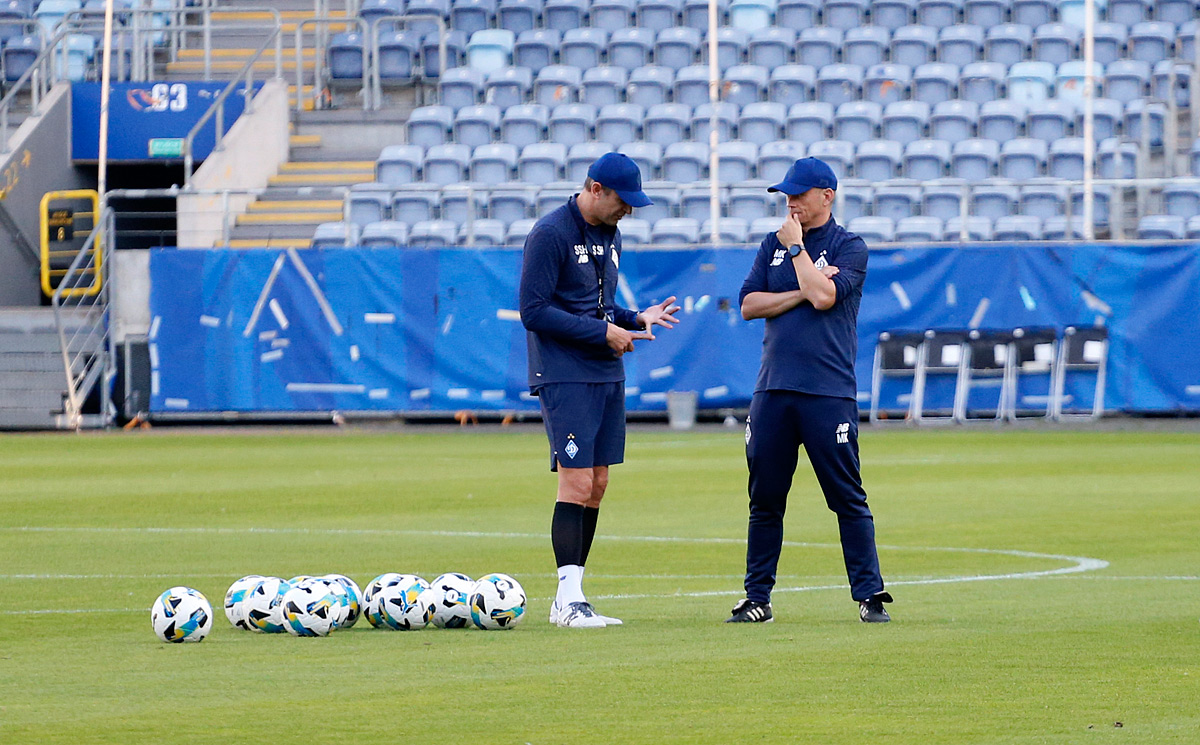 Maciej Kendzerek and Oleksandr Shovkovskyi. Photo - A. Popov
— How did you receive the offer of cooperation from Dynamo’s head coach Oleksandr Shovkovskyi?
— We met even before I joined the club. We talked during one of Dynamo’s visits to Lublin. On my part, I explained and showed how I work. A typical introductory conversation.
I know that Dynamo representatives, scouts, called different people to get more information about me. And after a positive result of such a, conditionally speaking, check, I was invited to meet with Mr. Shovkovskyi. We chatted a bit in Lublin, and a week later, I was offered to join the club.
— What are your duties in Dynamo’s coaching staff, and how is your adaptation to the team going?
— I’m working better and better, but there is still some adaptation issue. Of course, first of all, it’s the language issue. Even at the football level, the language differs a little from ours. But I’m learning, and I want to learn the language. So I’m working better and better every day.
As for my duties, I am responsible for a lot, because there’s quite a wide range of work at Dynamo. The head coach has five assistants, and the workload on each of them is quite large. Sometimes, in coaching staffs each assistant is responsible only for something specific, for example, for the team’s defensive play. But here, everyone is involved in the overall training process. Let each have their responsibilities, but overall it’s about the collective work of the entire coaching staff.
— Do you think this job is necessary for you? It’s not easy, and given the circumstances, will it contribute to your development as a coach? Because sooner or later, you will return to Poland, wanting to coach top division teams again.
— Of course, I considered this when accepting Dynamo’s offer. I think this is very developmental work, considering the level of players at Dynamo. I don’t want to boast too much about the team, but we really have a strong squad, two players for each position, and they are of very high quality. Therefore, I think working with such players suits me; it is definitely a step forward for my development as a coach.
Translation and stylistic adaptation — Dynamo.kiev.ua, hyperlink required if using material!