An interview with Ihor Paskiv, former forward of Karpaty, Lviv, and Donetsk Metalurh, who has been holding back the Russian invasion in the hottest frontlines for four years.
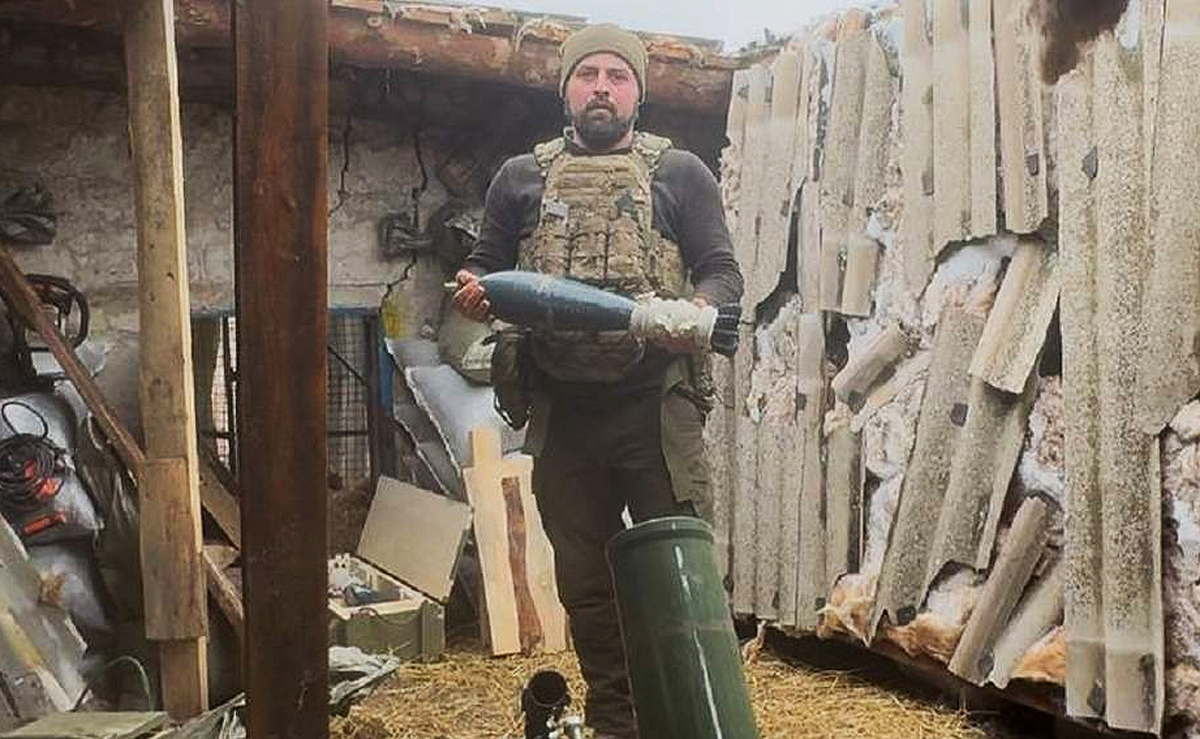 Ihor Paskiv
— What is your military profession?
— Mortarman. Currently, I am directly the gun commander in a self-propelled artillery battery.
— If we were talking four years ago, would these terms mean anything to you?
— I think so (smiles). I was not a military person, had never held a weapon. But on June 6, 2022, I went to the front. It all started on March 13 when I received an order — I volunteered to fight.
— Were you in Poland when the full-scale invasion started?
— I played football in Poland for ten years, working in a non-sport-related job. I returned home during the winter vacation, thinking I would spend a month in Lviv with my wife and child. February 24 was a hard day for me also because I didn’t precisely know what I would do next. It was a complete unknown. Then I analyzed everything and realized I needed to act. Physically healthy, mentally balanced — why not join the Territorial Defense?
— How did you acquire military skills?
— We were taken to a range, and we dropped three mines each on calculation. There was no combat experience, only theory. And two days later, we were sent to Kharkiv region. I also fought in the Danube direction, went through Soledar, specifically the battles for the village Rozdolivka. There were very heavy, hellish encounters, and our battalion took part in important mortar battles. We spent 13 months there.
— How much has the war changed you?
— We all change a lot here. In my case, my attitude toward life changed. I had a lot of time to rethink myself, evaluate my actions, think about what I did right and wrong. You spend your life playing football, feeling the euphoria of the game. And in war, you have a weapon, and you can only rely on it.
— Does your football past help you?
— Football is played by smart people, while dummies just run (smiles). Take peripheral vision on the field, for example — it has come in very handy here. A drone flies by or a mine lies on the road, and you manage to orient yourself — these skills have saved me many times.
— What is the hardest thing for you in war?
— I have seen many terrible things. Absolutely different ones, which you’d rather not recall. But the worst is losing comrades.
— You mentioned rethinking the past. What do you consider to be the biggest mistake in your football career?
— When you’re young, you want everything at once, trying to conquer peaks. In my case, the fatal choice was the move from Karpaty to Donetsk Metalurh. If I had stayed in Lviv, things might have turned out differently. I went to Donetsk because Karpaty was playing in the First League and there were few chances given to young players. But Metalurh called, so I agreed. I went to training camp, proved myself, and stayed there. Vasyl Leskiv trained me so well in Lviv that I felt like a fish in water in Donetsk.
— A few guys from your class established themselves in professional football.
— Yura Furta played for Karpaty in the UPL, and Bohdan Kohut recently finished with Veres. There were many guys who played at the amateur level and in lower leagues. There’s also Oleksandr Shandor, who currently works as a referee in Premier League matches.
— In the 80s, a footballer with the same name and last name as you played for Metalist, Volyn, and Bukovyna. That Ihor Paskiv — is he a relative?
— That’s my uncle, my father’s brother. Thanks to my father and uncle, I became a footballer. They took me to training when I was little, I kicked the ball into the net, fell in love with football, and eventually joined the Karpaty school.
— In Metalurh, you encountered many interesting footballers. Who impressed you the most?
— The club’s policy was clear — management focused on foreigners. Out of 46 people registered, half played for the reserve. Dishlenkovich, Zakarlyuka, Zotov, Virt, Yaya Toure, Leandro, Ruben Gomeç — many stars from the main team were sent down to the second team. It was very interesting to try myself against them. Though there were plenty of accidental foreigners. The coach played an important role in all of this. For instance, when Slavoljub Muslin left, they no longer counted on Serbs Slobodan Marković, Bratislav Ristic, Boban Grnčarov. And they were great players — Marković later proved that in Tavriya.
— Which coach trusted you the most?
— Vitaliy Shevchenko started bringing me closer to the main team. However, Oleksandr Sevidov’s subsequent arrival changed everything. Overall, I felt most comfortable with Bohdan Blavatskyi, who coached me at Vinnytsia’s Niva and later in Poland for many years. He’s a wonderful psychologist and a great specialist.
— At the same time, you received many chances in Lviv under Bohdan Bandura. Was that the best moment of your career?
— I debuted for the team in September 2006, starting with two significant matches: against Dynamo-2, where I missed two great opportunities, and against Karpaty in the Ukrainian Cup. It was a big sensation — a first-league team knocked out the favorite in the derby.
— Karpaty lost in the penalty shootout, in which you did not participate. You entered the field early in the second half.
— I had a clear task from the coach — not to let Karpaty defenders calmly play the ball. I constantly ran, pressed, and gave my all. Before extra time, Mykola Baglay replaced me, then scored the post-match penalty.
— By the way, Baglay, like you, is now defending Ukraine with a weapon in hand.
— I haven’t crossed paths with Mykola at the front, but I can say that many of my ex-partners are currently fighting. For example, Taras Hamarnyk, who also played for Lviv in that match. In Vinnytsia, I played with Serhiy Chaban, who played for Karpaty — he has been fighting for a long time, and we also sometimes connect.
— Another partner of yours — Artur Hrytsenko — gave his life for Ukraine in 2022. He was also on the field then and even scored a goal.
— Artur was a fantastic person — I couldn’t believe he was gone. We had a significant age difference, but I never heard a bad word towards young guys from Artur. Only respect and good attitude from him. I also want to note other Lviv veterans who always supported us: mentioned Taras Hamarnyk, as well as Andriy Hanas and Yuriy Voytovych. Yura was the captain and a benchmark, a role model. Always smiling, positive, and a true locker room leader.
— We mentioned footballers who are currently at the front. Do you maintain relationships with many ex-partners?
— There’s a constant need for material support at war, though we don’t organize collections often. I have a small circle of communication with close friends-footballers. It so happened that from childhood I maintained relations with Furta and Kohut, whom I can even call my brothers. My close friend Andriy Blavatskyi, who played for Bila Tserkva’s Ros, also helps me a lot. Abroad, there are Maksym Malyarchuk, who was in Volyn under Kvartsyanyi, and Volodymyr Pidvirnyi and Vasyl Choba from Karpaty — even though they are far physically, they are always close in terms of aid. It’s a case where all these people call themselves to ask what is needed — I never ask.
— Your unit currently has an active collection for a vehicle.
— Yes, the situation is very difficult, as it’s not easy to find quality transport. It’s not just about money. By the way, in this context, I’d like to mention Karpaty. Recently, I was given funds collected by current footballers, with whom I’m not personally acquainted, but thanks to friends, I managed to approach them with a request. Additionally, Vladyslav Lupashko transferred money for the unit from his own side. I’ve known him for a long time — we crossed paths at Donetsk Metalurh when we were young guys.
— Are you satisfied with your career?
— I understand that I should have better realized myself. A very difficult moment is the transition from youth to adult football. Many players get lost at this stage. It was not easy for me either. When I went to Poland at a mature age, I severely injured myself. I tore my cruciate ligament, had surgery, and took a year to recover. When you’re out of football for such a long time, it’s extremely hard to return to the previous level later.
— Do you plan to return to football after the war?
— Probably not. I don’t see myself in football. First of all, I want to spend as much time as possible with my wife and daughter. I only get to see my child once a year. If lucky, then twice. They live abroad — my daughter reacts very badly to air alarms. I rarely go on leave: New Year and my daughter’s birthday in summer. I don’t know how it will be this year.
— Do you manage to follow football?
— I watch all Karpaty matches. I also keep up with the Ukrainian championship in general. My comrade is a Karpaty ultra, he’s the senior gunner. So, I have company for watching and discussing matches. We do everything to not miss a match. I didn’t play for the Karpaty first team, but it’s my native team. I support it with all my heart.
Lyubomyr Kuzmyak