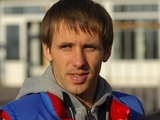
Former Dynamo player Hryhorii Yarmash, known for his performances for Vorskla, Zarya, and the national team of Ukraine, spoke about the Kyiv stage of his career.
— Hryhorii, how will you live after leaving Metalist 1925 along with Viktor Skrypnyk’s staff?
— After Viktor Anatoliyovych’s resignation was accepted, I returned home to Poltava. I spend time with my family and deal with household issues. I also play for the regional team FC Rakyta. I happily play football at an amateur level with my friends and keep myself in shape.
— Do you have a desire to return to work? Any plans?
— I definitely want to return! I have plans. God willing, they will come true.
— Where do you see yourself?
— I would like to work in Ukraine.
— How did you start playing football?
— The beginning was, as it is for all boys back then, romantic and intense (smiles, — note D. V.). I took my first steps in my native village of Zaliztsi in the Zboriv district of the Ternopil region at a small stadium near the school.
At one point, to live in our village and work at the distillery, Mikhail Mikhailovich Zabityvskiy came thanks to the director Volodymyr Vasilyovych Kuntzko. He had previously played football himself and became my first coach. We were organized into a team, started training three to four times a week, and went around the region for various mini-tournaments.
My father Petr Hryhorovych, along with Volodymyr Vasilyovych and other like-minded people, acted as patrons. They were fans of football, spent all their time with us, and helped with trips: bus, fuel, food, and so on.
— How did you then end up at Lviv UFK?
— Mikhail Mikhailovich learned about the opportunity for player tryouts and sent me and two other boys there. I showed myself well, and they kept me.
Everything at UFK was more professional. I left home and enrolled in a boarding school where I studied during the eighth and ninth grades. My coach there was Oleg Dmytrovych Rodin. We played in the Youth Football League (DYFL) and, of course, I will always remember my first international tournaments in Austria and Italy.
— The next step for you was Dynamo.
— Yes. We played the final part of the DYFL, and I was noticed by Pavlo Oleksandrovych Yakovenko, who was gathering a special class of players born in 1985.
I arrived in Ternopil for a week-long tryout at the end of summer, after which Pavlo Oleksandrovych invited my father and me to Kyiv at the beginning of September. We arrived at the Olympic base in Koncha-Zaspa, looked at the new building where I was supposed to live, the nearby school, the Dynamo base, and the training conditions.
— Did you hesitate long?
— Of course not! Compared to the boarding school… Now there is artificial turf there, but before, the training fields were, to put it mildly, not great. When I saw everything in Kyiv, I said, “If you keep me, I’m staying!” (smiles, — note D. V.).
— Back then, Yakovenko seemed to grab everything that was available across the former USSR for his special class. What was the loudest “theft”?
— The loudest was Toma Milevskyi. He had already played for Belarus. I remember when we went with the U-17 Ukrainian national team to our first qualifying competitions, they didn’t even risk including Toma in the squad to avoid sanctions. After he accepted Ukrainian citizenship, he started playing for us. Belarus didn’t want to let him go. He was indeed one of the biggest talents.
— There are rumors that you personally were outshone by a larger number of boys from the special class and that you managed to succeed more due to your insane work ethic. Do you agree?
— Indeed, that was the case. Pavlo Oleksandrovych told me that he had been whispered to, saying: “Why do you need this awkward one?”. However, as far as I know, his response was simple: “He has burning eyes and he wants it.”
Honestly, I can’t imagine my career without desire and hard work. My parents instilled such a character in me. I saw that there were more talented, more technical, faster guys. Well, I relied on physical health. The right tips from family, friends, and coaches also helped.
Someone among great coaches once said that a person could have only 2% talent, and everything else needs to be developed. Well, I might have had 0.5% or maybe 0.4% talent (smiles, — note D. V.).
— Artem Milevskyi and Oleksandr Aliyev were the biggest talents among you?
— I wouldn’t say that they were the most talented. Each stood out in their own way. I don’t want to offend anyone. Perhaps they were a bit more prominent and stronger. Both certainly deserved to reach a top level. How they took advantage of this chance is already an individual matter.
— What distinguished Milevskyi?
— Whatever pass you gave him, he could control the ball and navigate practically any situation under pressure. He also had unconventional technique and made decisions that even his partners did not expect (smiles, — note D. V.).
— Was Aliyev already at 16 with his crazy shot?
— Yes, it was already evident. He had a small foot. Plus, he himself mentioned in his interviews that he trained his shot as a child with his father. Later, he successfully used that in the game.
— Who is the biggest undiscovered talent from the special class?
— Well, injuries prevented Vova Samborsky. He played a bit for FC Kharkiv, but I think he could have achieved more.
— It’s no secret that Yakovenko always placed great emphasis on discipline. How did that manifest itself in you?
— We had a schedule: three training sessions and school. Periodically, Yakovenko’s assistants would walk through the rooms and check for cleanliness and order. Some managed well, while others did not. He also monitored our recovery — he would turn off the lights to help us fall asleep and rest faster (smiles, — note D. V.).
— What did you remember most from the disciplinary moments?
— What I remember is that every evening they would come to our floor and just turn off all the machines in the control panel so that there would be no light anywhere. And what could we do? Back then smartphones didn’t exist. Maybe one or two had Nokia 3310, on which you could play “Snake.” The others had to either talk or go to sleep.
— Did you ever sneak out from the base?
— Well, maybe we did, but no one knew about it. You also need to know how to sneak out (smiles, — note D. V.).
— What was your toughest training day in the special class?
— Probably when we had four training sessions. I remember that at 7:00 we were at the indoor arena. We went there in the dark since it was winter. We even had to wake up the caretaker to turn on the lights for us (smiles, — note D. V.).
Then we went to school for a few lessons, followed by lunch and sessions in the gym. After the gym, we had field training, then dinner, and around eight in the evening we went to the swimming pool. The water was very cold, so while swimming, we tried not to stop. Sometimes the day would end not with the swimming pool, but with gymnastics on trampolines at the Suvorov Military School.
We returned to the base around 21:30. So the day was intense. It was harder mostly because of its volume.
— After the special class you went through Dynamo-3, Dynamo-2, the reserves, and even joined the training with the first team. How much did the level of the main team differ from the youth teams at that time?
— A lot. Once, when there weren't enough people at the first team’s practice, Volodymyr Ivanovych Onyshchenko sent me to play with them. I was matched up one-on-one with Oleg Husyev — he was something, damn. After that training, I had to sleep for two days (smiles, — note D. V.).
— Husyev was the strongest player in Dynamo at your position as a right back?
— I think so. When Husyev played as a right back, he was top-notch. Because he had experience playing in the role of a winger, he excelled in defense and attack. So Husyev played like modern wing-backs, who operate along the entire flank.
— Is it true that Tiberiu Ghioane was a daydreamer?
— Well, he was. However, I didn’t notice anything extraordinary during matches when he came to play for Dynamo-2. It was clear on the field that he was a quality player who could make unconventional decisions. Sometimes he could do something odd, but he did it with such a calm expression that no one particularly paid attention (smiles, — note D. V.). You watch and think: “Well, that’s just him.”
— Were there any interesting situations?
— Well, if he didn’t like something on the field or was provoked, he could easily give the provocateur a slap and that was it. He’d get a red card and walk away.
— Do you remember the size of your first salary at Dynamo?
— In Dynamo-3, my initial salary was about 150 dollars, I think. Then it was 300 dollars at Dynamo-2, eventually raised to 450 dollars.
— What did you spend it on?
— I gave almost everything to my parents.
— Who from the main team then drove the fanciest car?
— Well, Laszlo Bodnar loved fancy cars. He had both a Mercedes and a BMW. Then Toma took over this baton, but I wasn't in Dynamo by then (smiles, — note D. V.).
— Who liked to race the most?
— Well, Bodnar liked it and Goran Gavranchich did too. They’d race around. There were even races organized. Fortunately, everything went without incident.
— Did you often interact with the Surkis brothers?
— Hryhorii Mykhailovych and Ihor Mykhailovych came to the academy games. Later, when I was playing for Dynamo-2, Ihor Mykhailovych was always present in the stands at home matches. Hryhorii Mykhailovych also attended games whenever possible.
I remember when Hryhorii Mykhailovych would come into the locker room, he always called me “namesake.” He would say: “Hello, namesake! How are you?” I’d reply: “Good day, Hryhorii Mykhailovych, everything is fine.”
— How did you leave Dynamo?
— I was called into the office, where I met with Yevhen Petrovych Kotelnikov. He indicated that Dynamo-2 was already counting on younger players, and I had the opportunity to go for a trial at Vorskla. I agreed since I realized that being in Kyiv was pointless for me.
Along with me, Den Onyshchenko went to Poltava (immediately on a contract), Denys Glavina, and Dima Brovkin. After some training period, I stayed with the team. Financial moments were not so important to me as the conditions for work. Vorskla had a good base where one could live, several quality fields. And the city of Poltava itself is great.
— Did Vorskla pay anything to Dynamo for you?
— I don’t think so. I still joke that “Vorskla” bought Onyshchenko and Glavina, and us with Brovkin were just a bonus (smiles, — note D. V.).
Dmytro Venkov