Last Tuesday in Kyiv at the House of Football, a press conference was held by the president of UAF Andriy Shevchenko, where he reported on the first year of his work in this position and also answered questions from media representatives and the football community.

As for the report for the past year, it was presented according to each item of Shevchenko’s program, which he announced immediately after his election. The process was conducted in the format of a demonstration of a prepared presentation on a large screen in combination with comments from those responsible for each item of the program.
Everything was visual and convincing. This is truly so; there’s no sarcasm here.
And the most interesting, from my point of view and from the perspective of colleagues with whom I exchanged opinions about the presentation, was the presentation on the first item of Shevchenko’s program, which included UAF's financial report for the past year. The slides showed, both overall and by categories, the income and expenses of the organization for that period. Everything is genuinely transparent, as Shevchenko promised, and interesting.
In general, a plus-minus similar assessment can also be given based on how the reporting for the other items of Shevchenko’s program was presented. But, however it may be, the main "highlight" of the presentation was indeed the financial report. Who paid UAF, for what they paid, and in what amount, and exactly the same — on the expense side.
And it would seem that on such a summary, the topic could be closed. If not for the broadcast on the YouTube channel “Vatsko Live” by the famous Ukrainian commentator Viktor Vatsko, who, sharing his impressions about what was written above, said:
“You know what the paradox is? I looked at these figures and caught myself thinking that I don't know: is it good or bad. I don’t know. For example, the expenses for the national team: it was written 6.8 million euros per year. Is that a lot, a little, or normal? I simply don’t know how it was before; I have nothing to compare it with.
The public organization FFU, and later UAF, never, never showed us such figures. They never went public to report on their activities, on how much they earned, how much they spent, what there was, for what, why. I just cannot recall Pavlychenko, Konkov, Surkis Hryhoriy Mykolayovych holding press conferences like this. Not there, gathering in a closed circle of their supporters, who only vote "for," but like this in front of everyone, for the public. So that they opened the figures of the activities of the organization that governs Ukrainian football. Everything has always been done quietly, “under the table”. I repeat once again — for their own, for those who vote "for."
So these tables with income and expenses — are just a statement of fact. And to say whether they work well or poorly; whether they are effective or ineffective; whether their predecessors were more effective than them — well, it’s simply impossible, because we stupidly have nothing to compare with.”
It turns out just how short a person's memory can be! After all, since the time when Grigory Surkis was at the helm of FFU, and the organization regularly reported at absolutely public and open Congresses about the past period (including financial aspects), not much time has passed.
But I don't intend to lie with words. To lie with words is not to move bags (it sounds different in the original, but I will remain within the framework of normative vocabulary).
So, for example. Screenshots, like manuscripts, do not burn. And they refresh the short memory of those who “stupidly have nothing to compare.”
Below, as an example, I provide excerpts from the official brochure of the IX Congress of FFU, which took place on September 14, 2007. Such brochures have always been absolutely public documents and contained, among other things, the financial report on the activities of FFU, the audit report, and much more. Useful statistics, especially for comparative analysis. By the way, under Surkis, it could be found freely available on the official website of the federation.
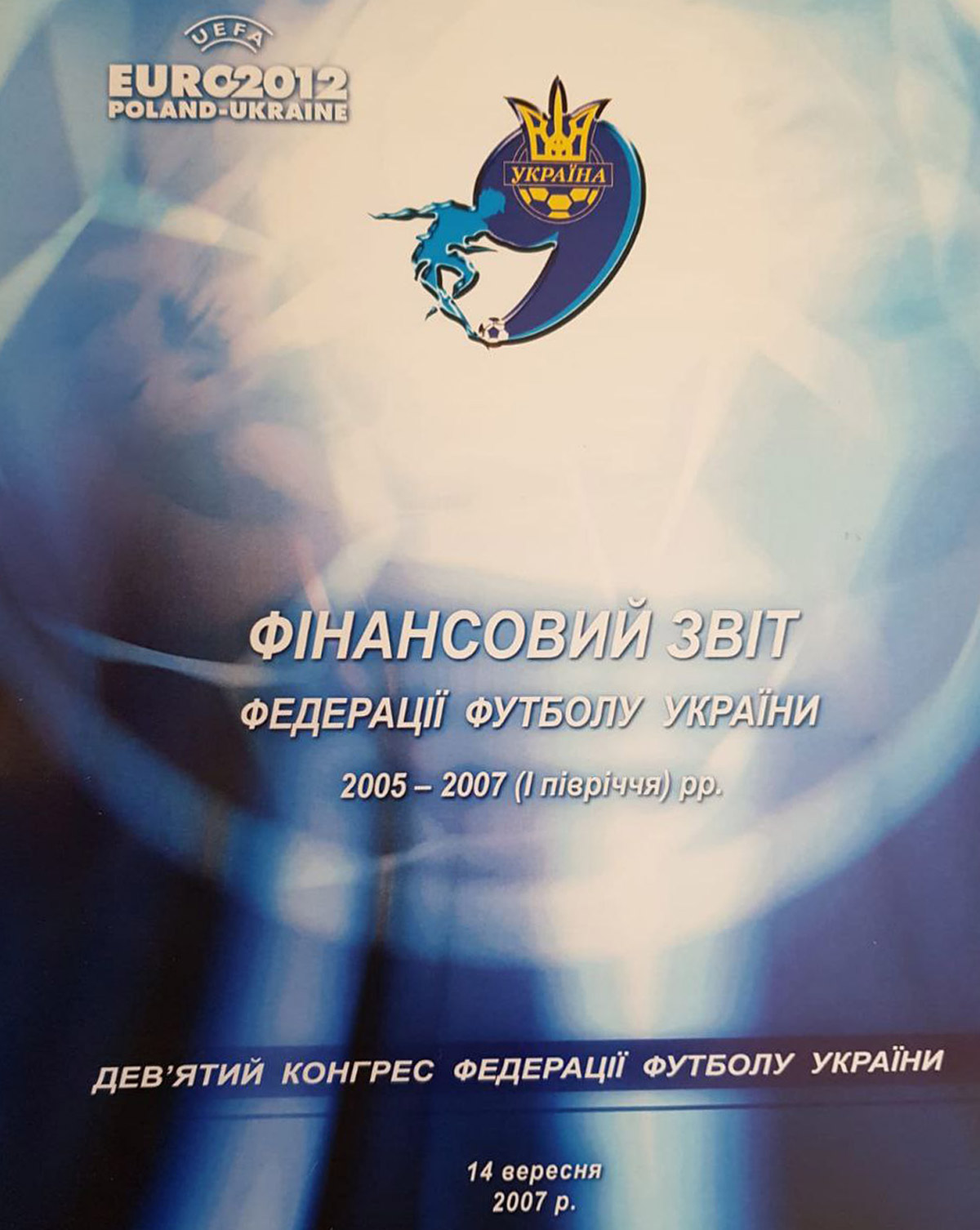
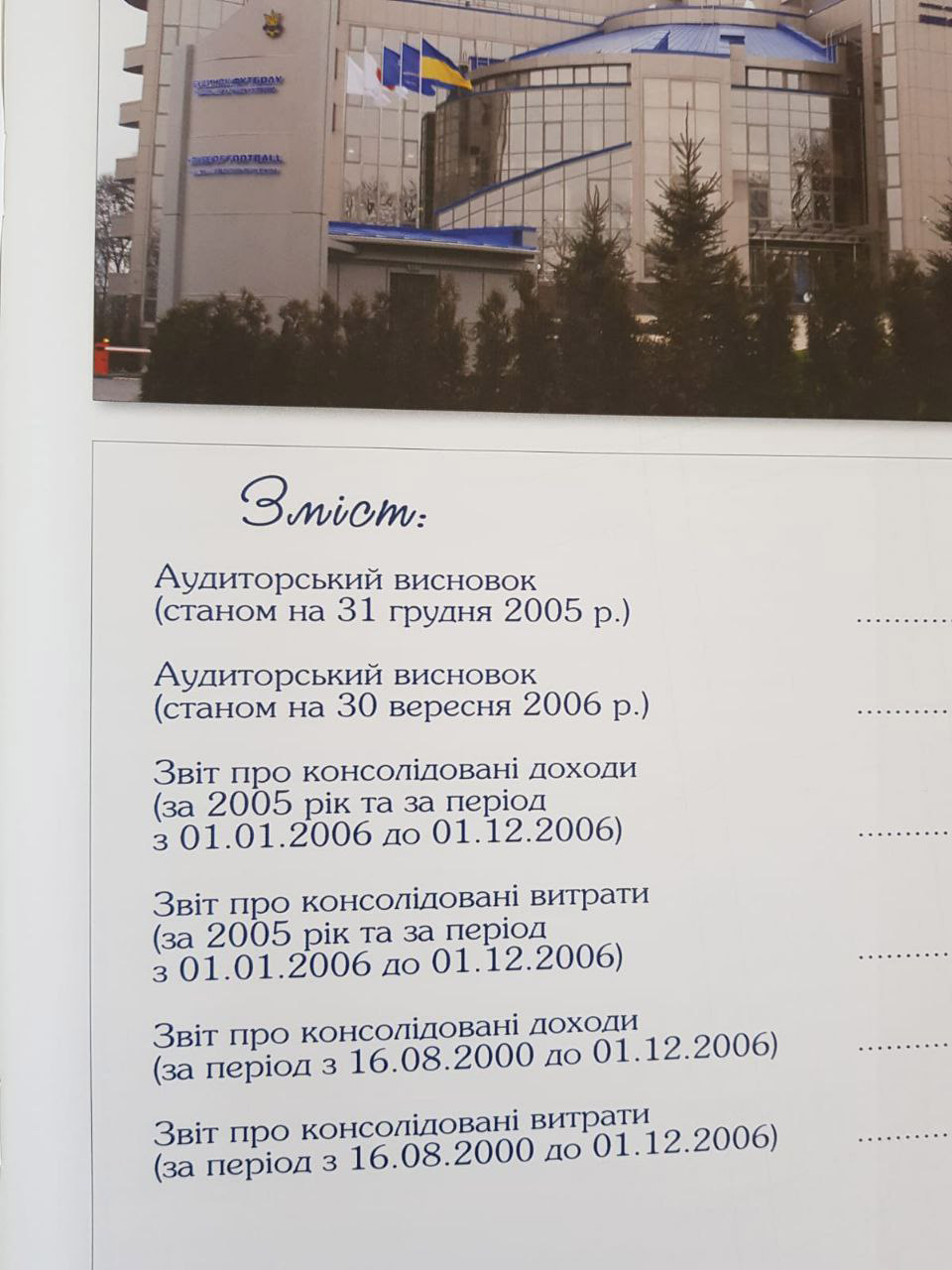
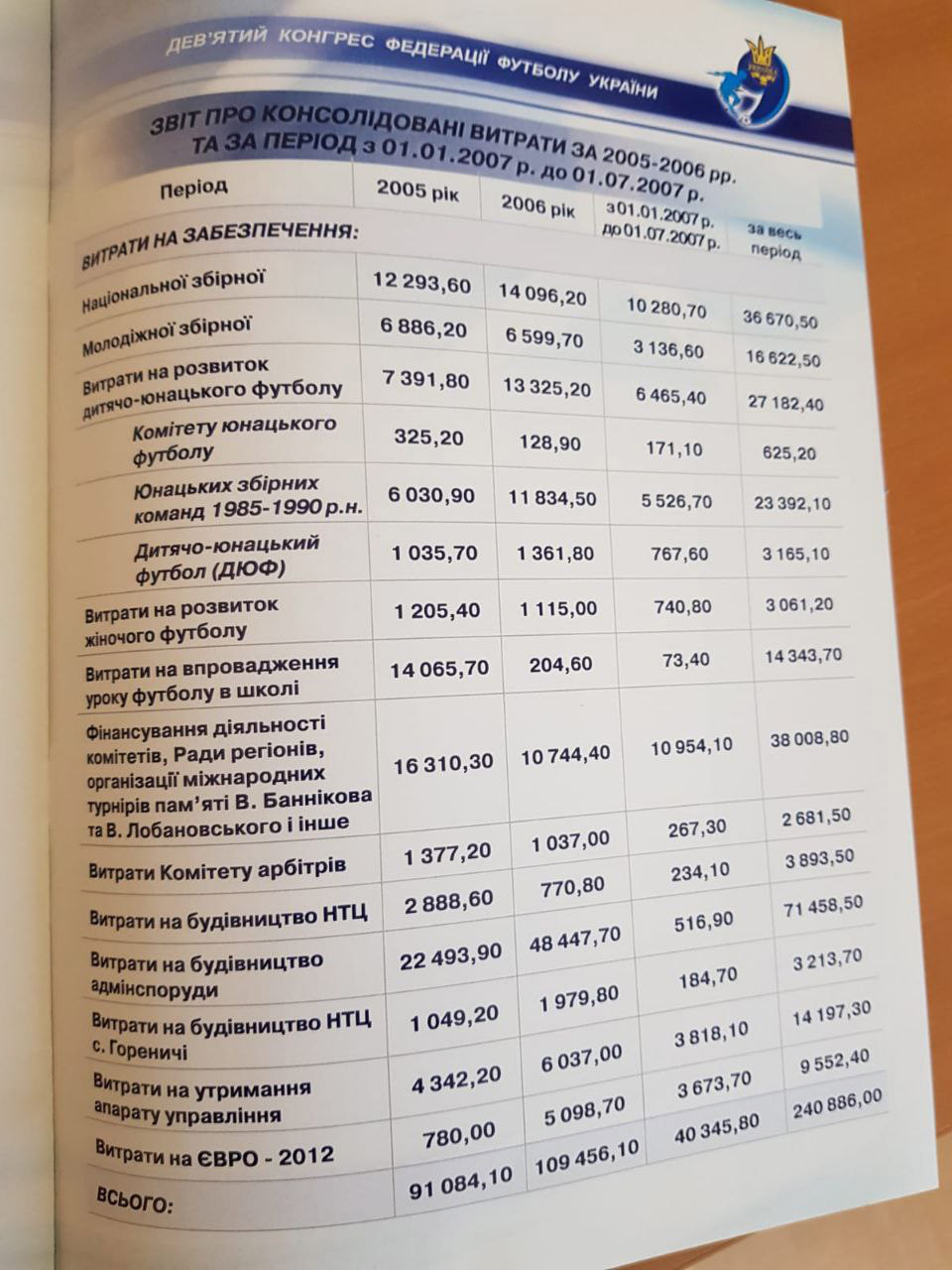
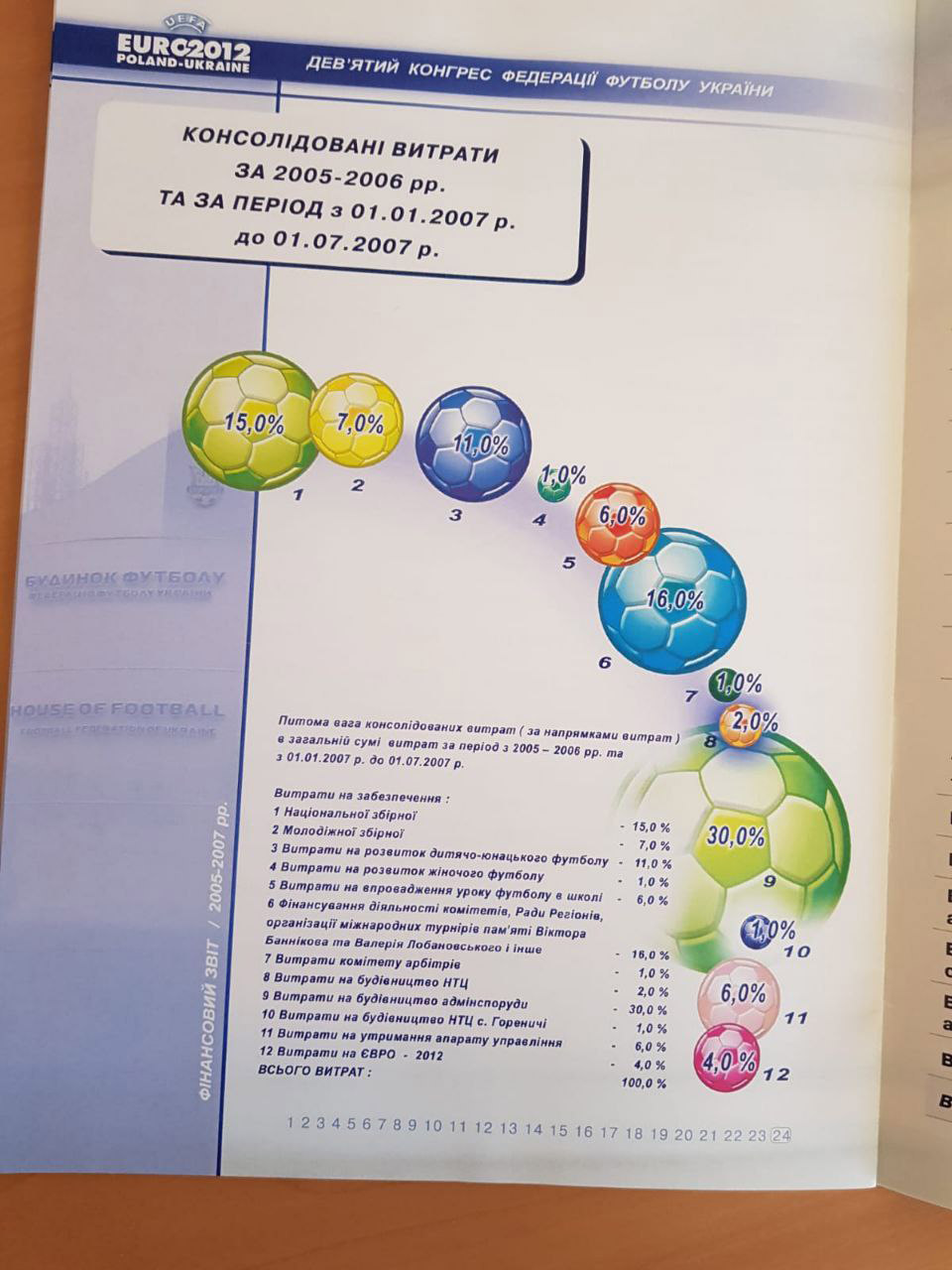
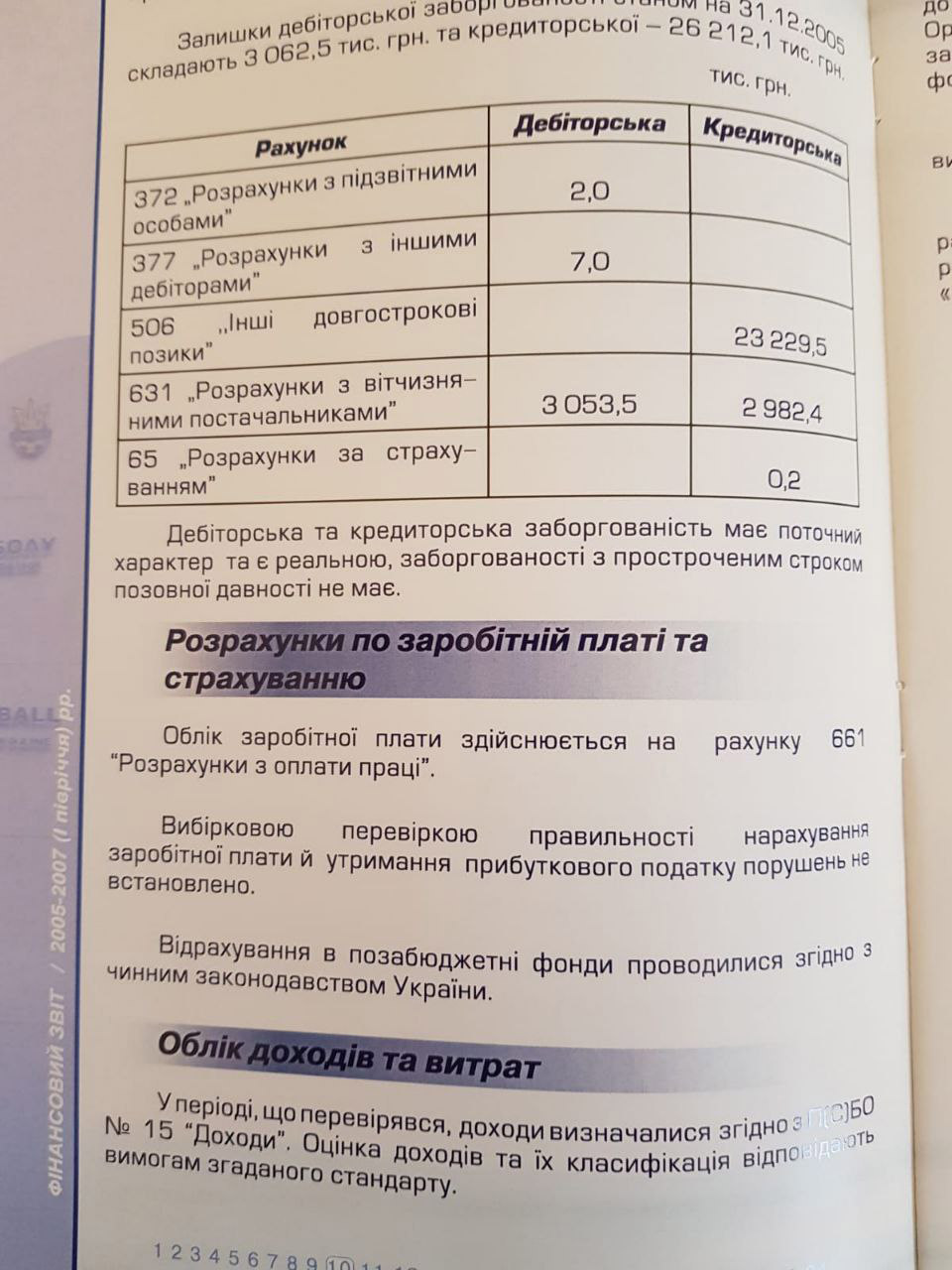
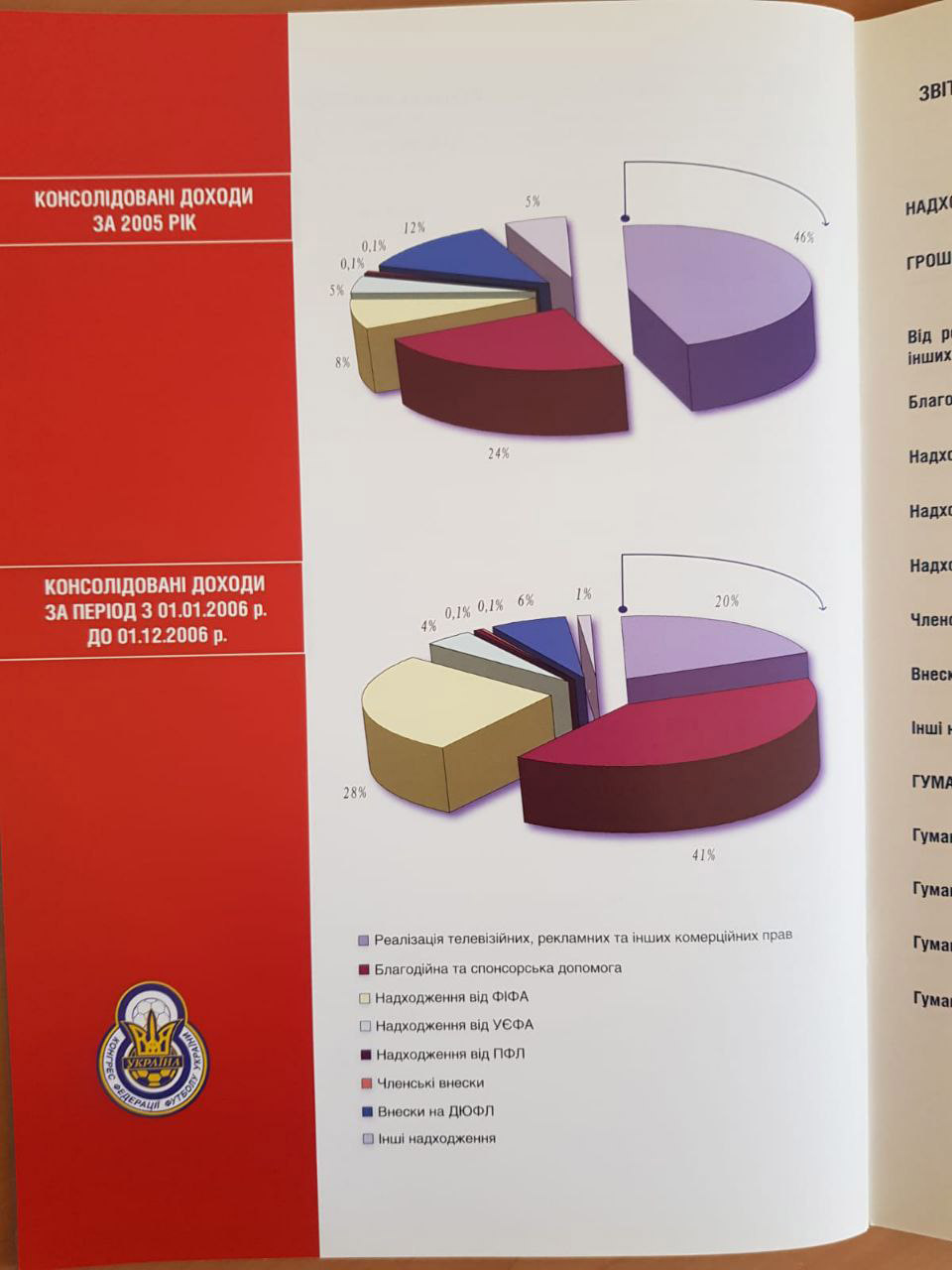
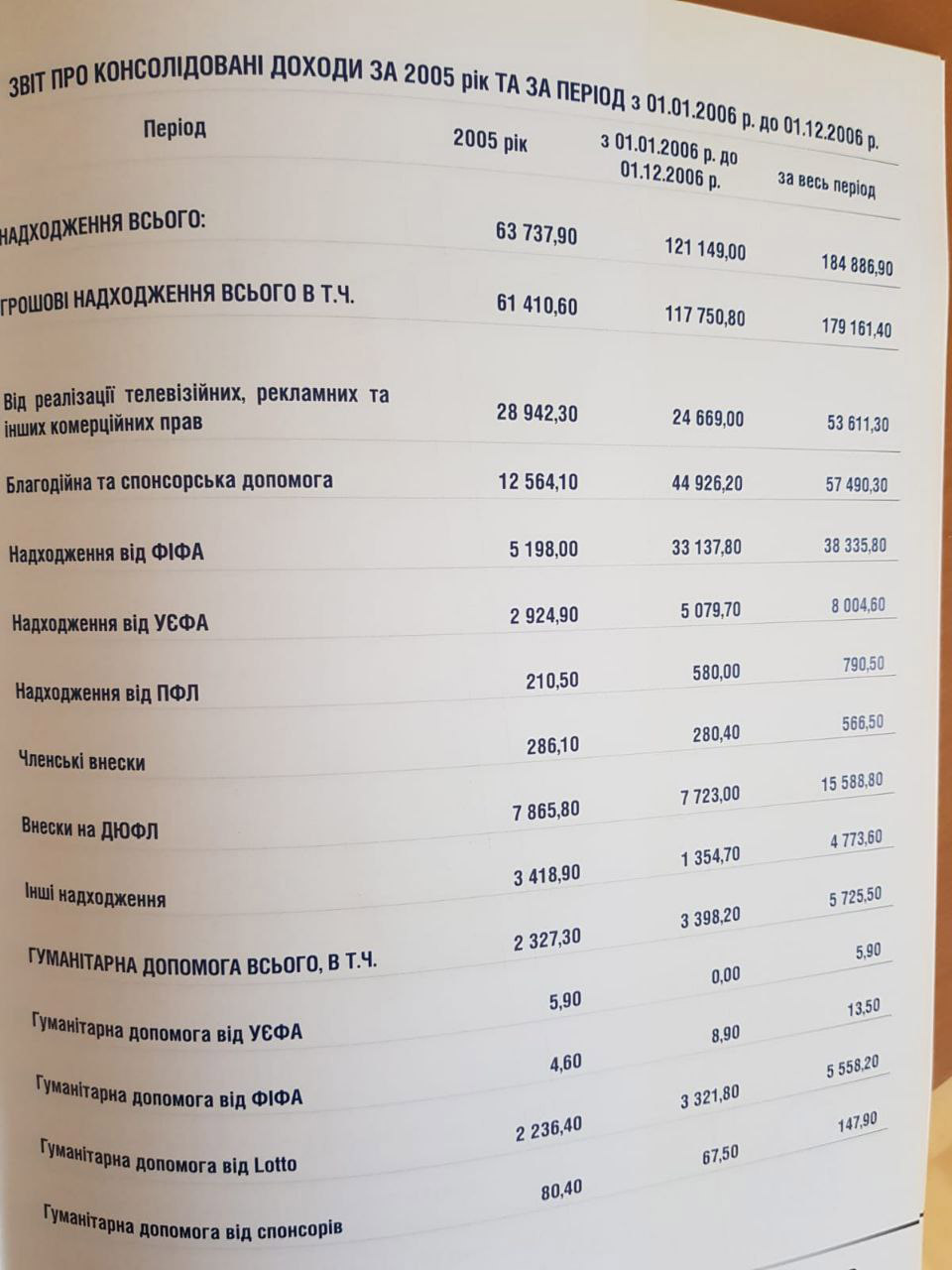
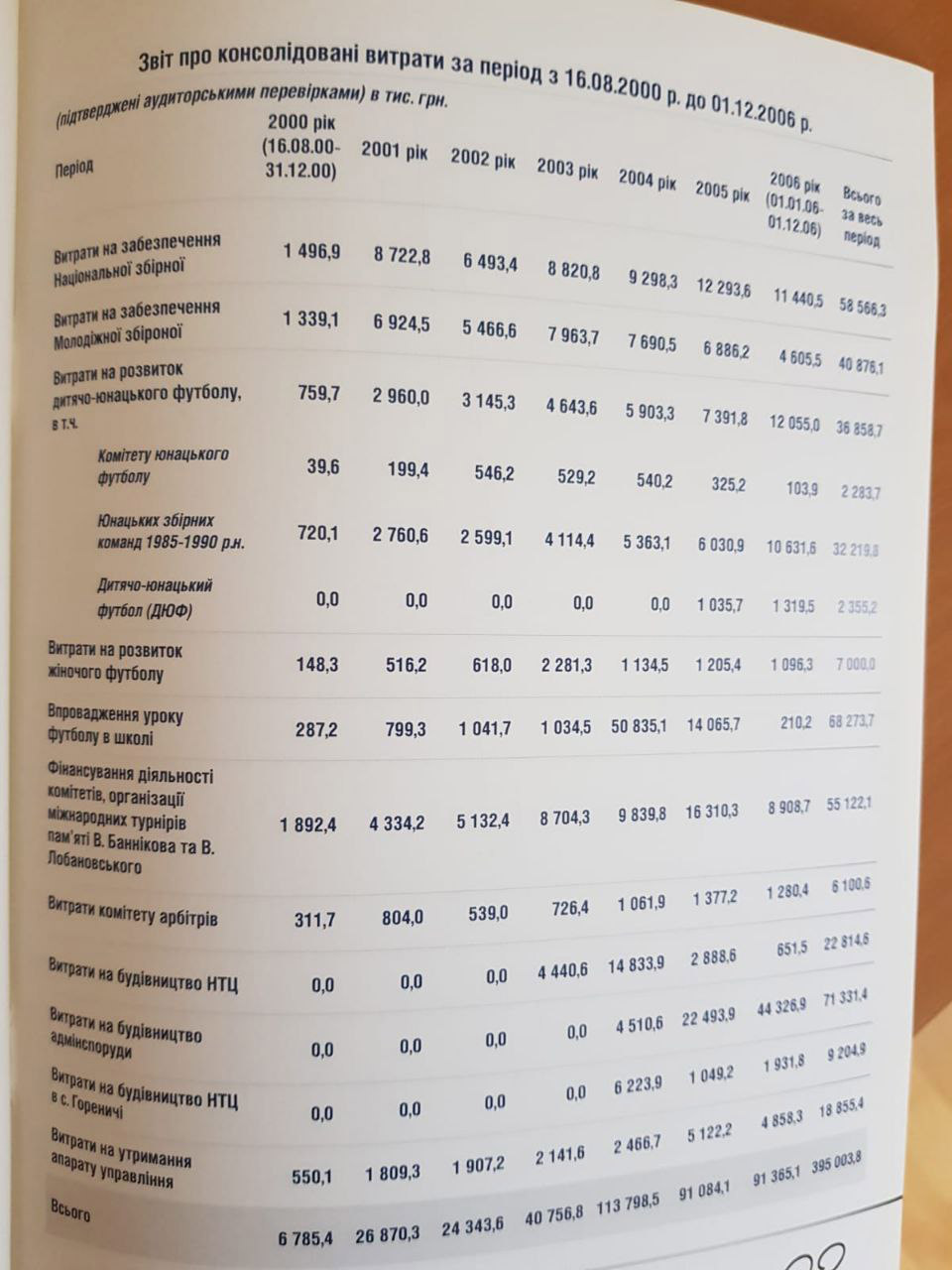
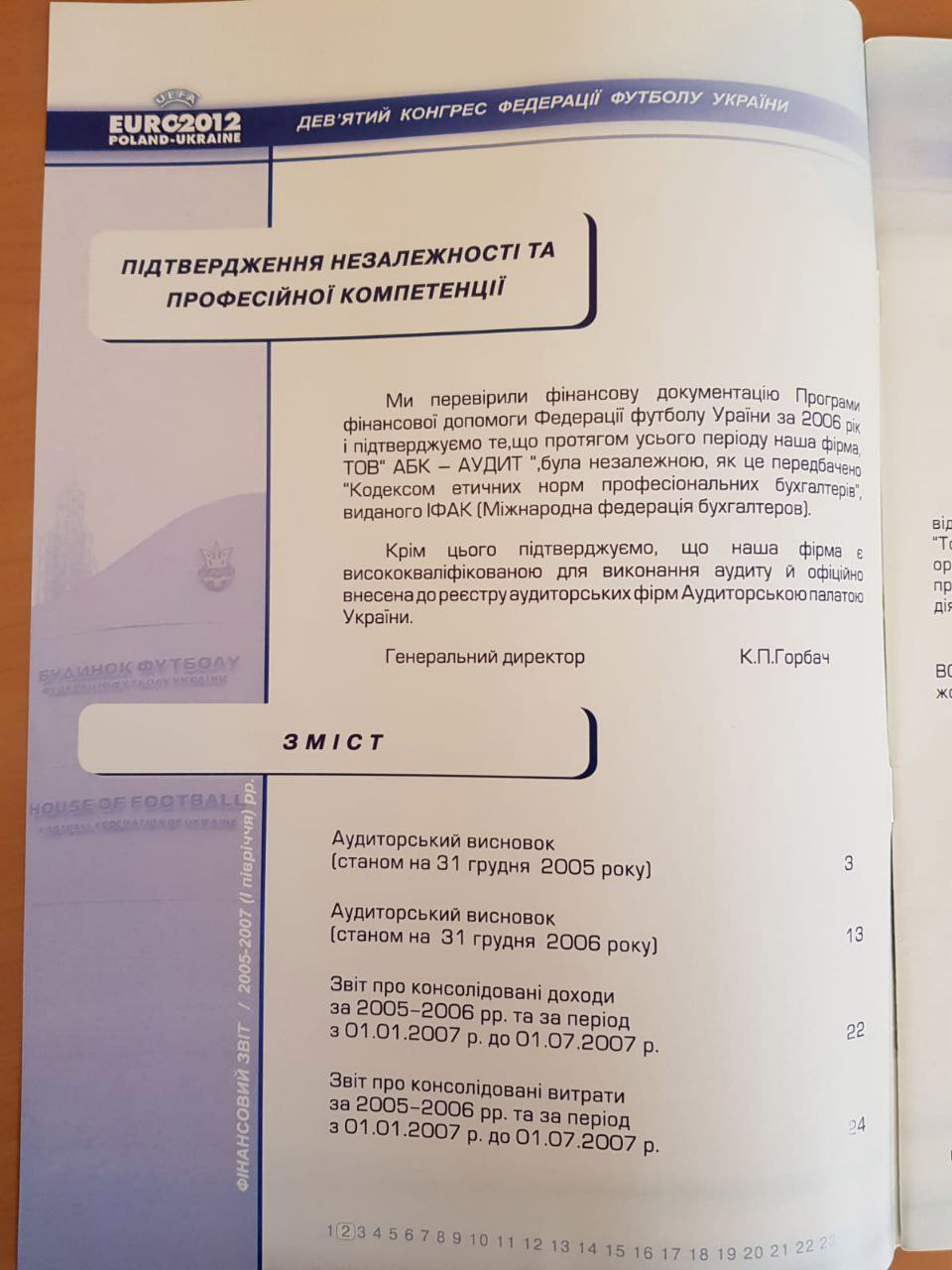
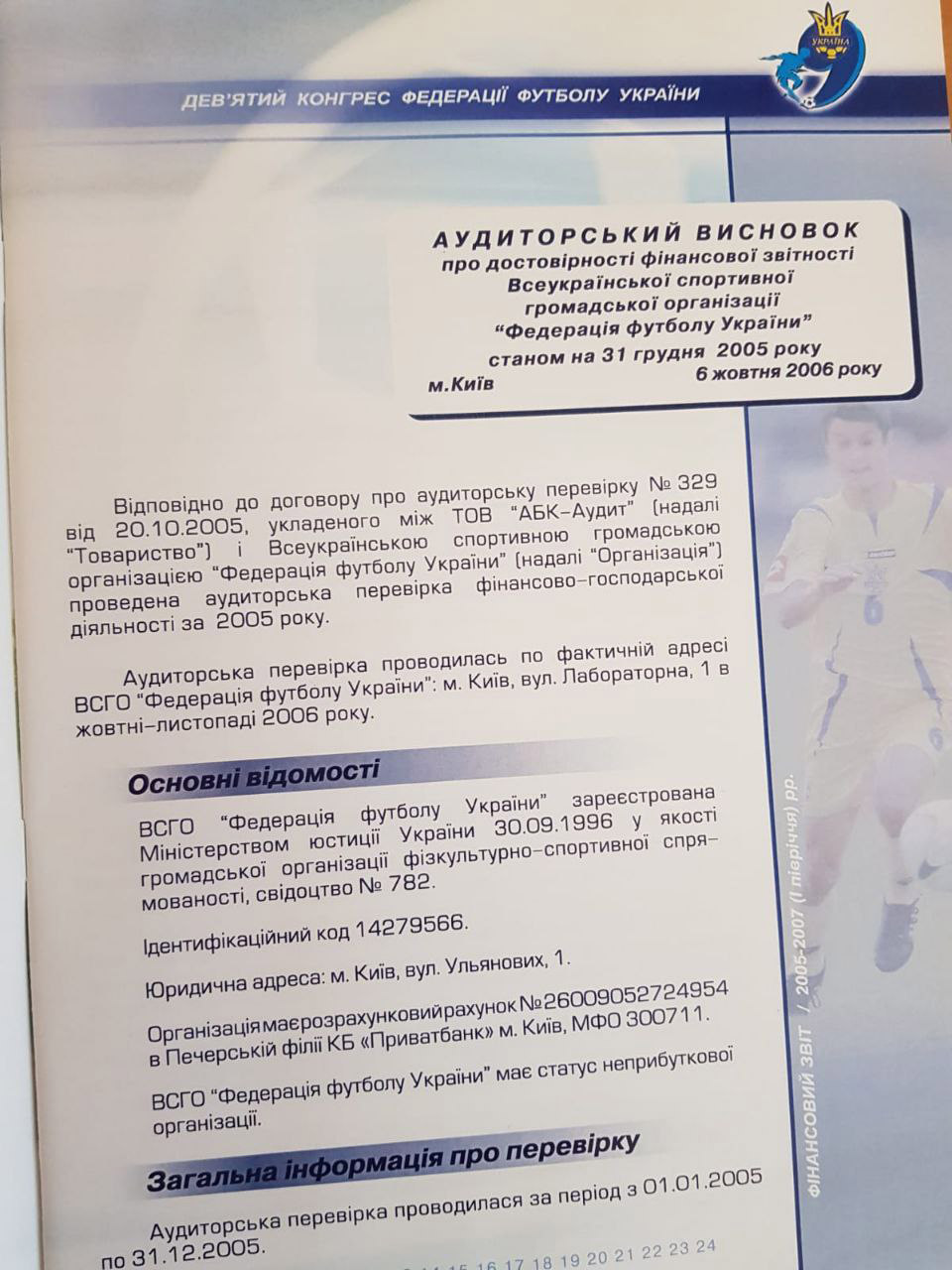
Is this enough to decisively refute the statement “FFU never, never showed us such figures”? Or should there be a dozen, another, or a third set of screenshots? Still, I hope that it's enough.
In conclusion, I would like to remind you of the report at the XIV Congress of FFU (September 2012) by the executive director of the organization Alexander Bandurko. This was the last Congress of FFU when Grigory Surkis was its president. This report, besides various kinds of reports, contained the following data:
“As of August 31, 2012, the balances in the accounts of the Football Federation are — I will slightly round for easier perception:
3 million 700 thousand UAH.
100 thousand Swiss francs
414 thousand dollars
11 million 542 thousand euros.
Considering the expected receipts from UEFA in the amount of 10 million 100 thousand euros and FIFA in the amount of 33 thousand US dollars, as well as funds from FIFA's and UEFA's investment projects (the "GOAL" and "Hat-trick" programs) and the value of apartments owned by FFU, the resources of the Football Federation of Ukraine by the end of the year will amount to just over 37 million US dollars.
In total, over the past five years, FFU and its partner "UFI" spent more than 102 million US dollars on the development of football.
In short, we leave behind not empty granaries. And I sincerely wish the successor of Grigory Surkis to multiply this legacy for the development of domestic football.”
So, it turns out that under Grigory Surkis, not only was there a practice of transparent reporting on the financial activities of the organization at FFU: that team also ultimately reported that they left behind — 37 million US dollars in the accounts of FFU (where, by the way, they later went and into whose pockets is a very interesting question!). And this is not to mention such “trivia” as the erected House of Football, where Andriy Shevchenko reported on the first year of his activity as the president of UAF. By the way, this is in the traditions of complete transparency, the initiator of which upon coming to FFU was Mr. Surkis.
And the most important thing. And the most important thing is always the result. Concrete results of work. Not reporting, not presentations. But results. And since Viktor Vatsko apparently does not remember the reporting of FFU during the times of Grigory Surkis, maybe he also forgot whose management team of FFU gave Ukraine Euro 2012? It’s probably better to remind, as it turns out memory is a fragile thing. Especially since this is just the case when “stupidly have nothing to compare.” Ukraine was given the right to host the final part of Euro 2012 (together with Poland) precisely when FFU was headed by Grigory Surkis. That is the absolutely concrete and clear result of the activities of the country’s football association! A result that no one in Ukraine has ever repeated. And it's a big question when this will happen again...
Alexander POPOV
P. S. Dear Andriy Mykolayovych, don’t listen to bloggers like Vatsko. A journalist with a short memory is a questionable assistant. He doesn’t even suspect, unlike you, that yesterday's recipes for future success are not stored in useless paperwork, but are still relevant and in demand today and tomorrow. Maybe that's why your first pancake didn’t turn out lumpy...